Safety
Deep Cold on the Perimeter Highway Near Winnipeg: Staying Safe When Your Car Quits
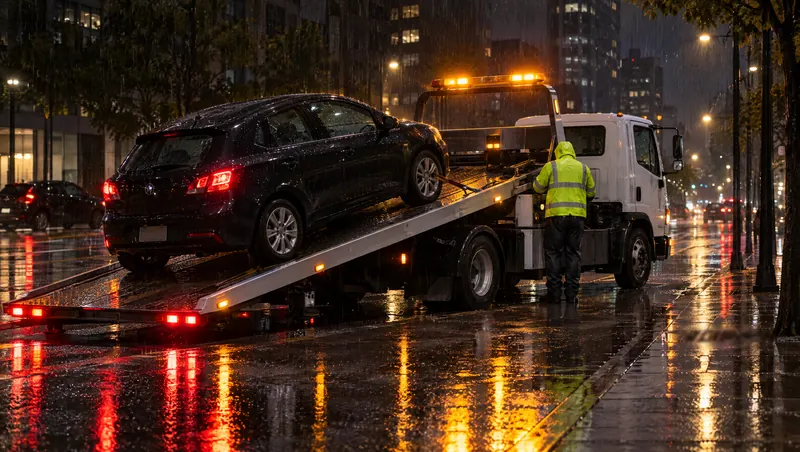
If your car quits on Winnipeg's Perimeter Highway in deep cold, pull as far onto the shoulder as you can, turn on your hazards and stay buckled in your seat. Keep the tailpipe clear if you run the engine for heat. Then call with your exact spot: North or South Perimeter, your direction and the nearest crossing road. Most of the Perimeter runs outside the city, so a clear location matters more out there.
Why is a breakdown on the Perimeter harder than one in town?
The Perimeter is a ring of about 90 km around Winnipeg. PTH 100 is the south half and PTH 101 is the north half. About three quarters of it lies outside city limits. Out there, you have open fields, few buildings and nowhere warm to walk to.
That changes the math on a cold night. In Osborne Village, a dead car means a coffee shop down the block. On an open stretch of the North Perimeter, it means your car is your only shelter.
Three things make it tougher:
- Wind with nothing to stop it. Flat prairie lets the wind run straight across the road and through your coat.
- Blowing snow. Environment Canada's 1981 to 2010 normals for Richardson International Airport log blowing snow on about 19 days a year. It can hide a stopped car until a driver is right on top of it.
- Short winter days. Rush hour home often happens in the dark. A shoulder that felt fine at noon feels very different at night.
Why does a battery quit out there on the coldest days?
Cold slows the chemistry inside a battery. At the same time, a cold engine is harder to turn over. So a battery that started fine in October can give up in January.
Winnipeg gets plenty of that cold. The same airport normals show an average January high of about minus 11 C and an average low of about minus 21 C. Lows drop below minus 30 C on about 13 days a year.
The Perimeter adds its own strain. Your heater fan, rear defroster, seat heaters and headlights all pull power at once on a dark, snowy drive. A weak battery or a failing alternator can lose that fight on the highway, not just in your driveway.
Warning signs before it dies
- The engine cranked slowly this morning, then caught.
- Your headlights dim when you stop at a light, then brighten when you speed up.
- A battery or charging light flickers on the dash.
- The heater fan slows down on its own.
If you see these signs, don't head out onto the Perimeter at night. Get the battery tested first. If it has already died somewhere safe, a jump start may get you to a shop.
What should you do the moment the car starts to fail?
You often get a few seconds of warning. Use them.
- Signal and ease right. Get onto the shoulder while you still have power steering and brakes that work well.
- Get as far off the lane as you can. Stay clear of the lane line, but don't drive into deep snow you can't get out of.
- Hazards on right away. In blowing snow, they're how other drivers find you.
- Avoid stopping at an intersection. Parts of the Perimeter still cross other roads at grade. If you can roll past a crossing before you stop, do it. Cross traffic is the risk there.
Manitoba 511 notes that stopping distances grow a lot in winter. It says to expect up to four times the distance on packed snow, and up to 12 times on ice. The driver behind you may not stop as fast as you hope. That's why getting off the lane matters so much.
If anyone is hurt, or your car is stopped in a live lane, call 911 first.
Should you stay in the car or walk for help?
Stay in the car. Public Safety Canada's winter storm advice says if you're trapped, stay inside your vehicle and keep the tailpipe clear of snow and ice.
Walking is the bigger danger out there. Environment Canada says at a wind chill of minus 40 to minus 47, exposed skin can freeze after 5 to 10 minutes outside. Winnipeg's airport normals show wind chill below minus 30 on about 44 days a year. A walk to the nearest gas station on an open stretch can take much longer than that.
- Keep your seatbelt on. A car on the shoulder can still be hit.
- If the engine still runs, use it for heat in short spells. Step out only to clear the tailpipe, and only on the side away from traffic.
- If the engine is dead, layer up before your body heat drops. Hat, gloves, blanket.
- Keep a dome light or flashlight handy, so you can see and be seen.
- Keep your phone in an inside pocket. Lower its brightness to save the battery.
How do you tell a dispatcher where you are on the Perimeter?
"I'm on the Perimeter" covers about 90 km. Your helper needs much more than that. Give these four things:
- North or South Perimeter. PTH 101 or PTH 100.
- Your direction. Eastbound or westbound on the south half, for example. Look at the last sign you passed.
- The last road you crossed. McGillivray, St. Mary's Road, Pembina Highway or Highway 1, whatever you just passed.
- Inside or outside the ring. Are you on the side toward the city, or the side toward open country?
Your phone's map app can show your spot as a pin. Read the closest road names off it if signs are buried in snow. When you request help online, your location goes along with it.
Is there construction on the South Perimeter this winter?
Yes. Manitoba Transportation and Infrastructure lists the McGillivray interchange (PTH 100 at PTH 3, near Oak Bluff) as under construction, with work planned from 2026 to 2029. Expect lane shifts, narrow shoulders and work zones there.
A stall in a work zone leaves less room to pull over. If you can, roll through the zone before you stop. If you can't, stay in the car with your hazards on and call.
The interchange at St. Mary's Road opened in October 2024 with roundabouts at its two intersections. The province has also closed some median openings at stop-sign crossings. Your route may look different from last winter, so name the crossing road you see on the signs.
What do passing drivers have to do for your tow truck?
Manitoba's Highway Traffic Act tells drivers to slow down for a stopped tow truck or roadside service vehicle with its lights on. That's no more than 60 km/h where the limit is 80 km/h or more. Where there are two lanes going their way, they must move over a lane if it's safe.
That rule does not cover traffic on the far side of a divided highway. The Perimeter is divided, so oncoming traffic keeps going at speed. Wait on the side away from the lanes, not in the median.
What should be in your car before a winter drive on the Perimeter?
Manitoba 511 tells drivers to carry a winter emergency car kit. Public Safety Canada and Transport Canada list what goes in it. These are the items that matter most on an open stretch at night:
- A blanket, plus extra clothing and shoes. A heat-reflective blanket is best.
- A wind-up flashlight and a whistle.
- A reflective vest, and a warning light or road flares, so others can see you.
- Water in plastic bottles, so they won't break if they freeze.
- A small shovel, a scraper and a snowbrush.
- Sand, salt or non-clumping cat litter, plus jumper cables.
- A charged phone. Don't pick it up while you drive.
Public Safety Canada also says to go into a winter storm with a full tank of gas. A full tank means more heat if you end up waiting.
How do you check the Perimeter before you leave?
Look at Manitoba 511, or dial 511. It shows closures and road conditions. Its Track My Plow map shows where snowplows are working. The province says it's illegal to drive on a closed road, and drivers may be fined.
Since January 2026, the province can run snow clearing on PTH 100 and 101 around the clock when severe weather is forecast or underway. Give those plows room. Manitoba 511 says never pass a working plow from behind.
If the weather turns while you drive, the province's advice is to turn back or find a safe place to stop. A gas station lot beats the shoulder every time.
Jump start or tow when you're stuck out there?
If the engine cranked slowly or clicked, a jump often works. If the car ran fine, then lost power while you drove, the alternator may be failing. A jump won't last long, and a car tow to a shop is the safer call. Slid off the shoulder into the snow but not damaged? Ask about a winch-out. That service covers cars close to the road.
How does Sentinel help on a Perimeter call?
Sentinel Towing is a towing and roadside network, not a tow company. A vetted local partner does the jump, the winch-out or the tow. We text you a locked price before anyone is dispatched. Then we keep checking on you by text until your driver arrives, and you get their name, photo and truck. That's our Stay-With-You Promise. For roads and neighborhoods across the city, see the Winnipeg towing page.
Stuck right now? Call 1-888-TOW-1213, or request help online.
Perimeter Highway Cold Weather Questions
Can I run my engine for heat while I wait on the shoulder?
Yes, if the tailpipe is clear of snow and ice. A blocked tailpipe can push exhaust into the car. Run it in short spells and check behind the car when snow is piling up.
My car died near a traffic light on the Perimeter. What now?
Hazards on and stay buckled in. Cross traffic is the main risk at a crossing. If anyone is hurt or you're blocking a live lane, call 911 first. Don't let a stranger push you through the intersection.
Is it safer to walk to the nearest gas station?
Usually not on the Perimeter. Much of it is open country with long gaps between buildings. On a deep cold night, exposed skin can freeze fast. Your car is the best shelter you have.
Will Sentinel send help outside the city limits?
Yes, call from the Perimeter or just past it, including Headingley and Oak Bluff. Tell us the crossing road and your direction. We text your price before a partner is sent.
Rules change, so check the official source before you rely on it. Sources: Manitoba: South Perimeter projects, Manitoba: 24-7 Perimeter snow clearing, Manitoba: snow response and Track My Plow, Manitoba 511: winter driving, Manitoba Highway Traffic Act, s. 109.1, Public Safety Canada: winter storms, Public Safety Canada: emergency car kit, Transport Canada: winter driving kit, Environment Canada: wind chill, Environment Canada climate normals, Winnipeg airport.