Costs
What a Remote Stretch Adds to a Tow Price Near Thunder Bay
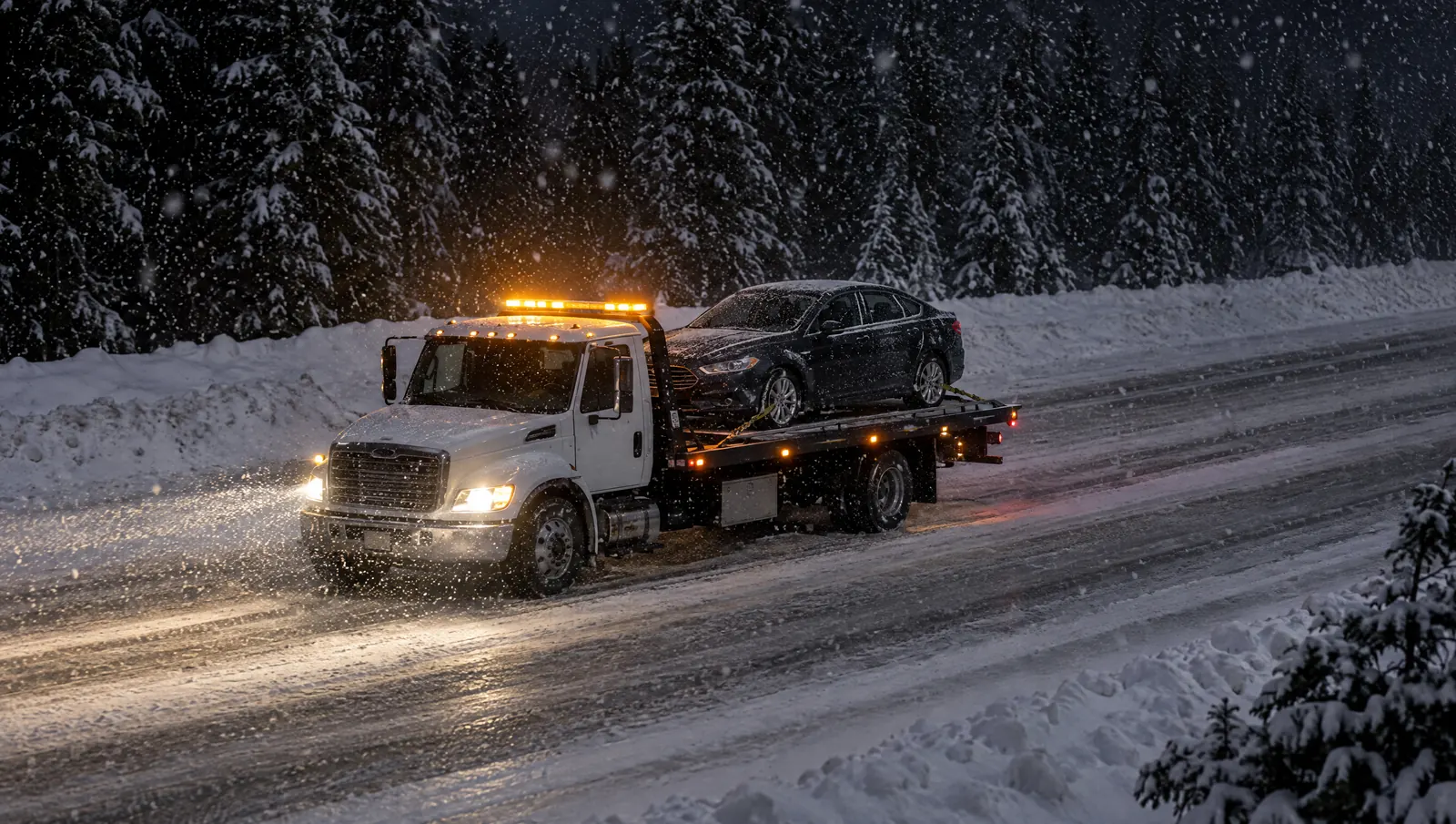
Near Thunder Bay, Ontario, the biggest thing in a tow price is how remote your car is. Inside the city, a driver has a short trip to you. Past Kakabeka Falls, Shabaqua Corners or Pass Lake, Highways 11 and 17 become long two-lane roads with few towns. More kilometers to reach you and more kilometers back shape the price. Your vehicle, the problem, the cold and your drop-off fill in the rest.
Why does a breakdown past Shabaqua Corners change the price?
West of the city, the Trans-Canada runs past Kakabeka Falls to Shabaqua Corners. There it splits. Highway 17 heads northwest toward Dryden and Kenora. Highway 11 heads west toward Atikokan.
Both roads are mostly two lanes from here on. Ontario's Highway 11 runs as a two-lane undivided road for nearly the whole way from Nipigon to Rainy River. Highway 17 runs two lanes through thick boreal forest. It meets Highway 11 a full 475 km before the Manitoba line.
So think of it this way. Your driver starts from wherever they are. Every kilometer between them and you is driven twice: once to reach you, and once with your car on the truck. A dead car on a quiet stretch past Shabaqua is a much longer job than a dead car in a lot in Intercity.
Is the road east to Nipigon any different?
A little. Nipigon is about 90 km east on Highways 11 and 17, which share one road out there. The first 36 km, from Balsam Street out to Highway 587 at Pass Lake, is twinned. The province finished twinning between Ouimet and Dorion in 2023. Much of the rest is still two lanes.
A twinned stretch gives your driver more room to work and to turn around. On a two-lane piece, the truck may have to go past you to find a safe place to turn. That adds distance. Tell us which way you were headed, so your driver comes up on the correct side.
What about Highway 61 south toward the border?
Highway 61 runs 61 km from the city to the Pigeon River Bridge, where it crosses into Minnesota. Neebing sits right south of the city along this road. A stall close to town and a stall near the bridge are very different trips.
If you are close to the border, decide where the car should go before you call. A tow back north into Thunder Bay is the usual choice.
What road work is on the map near Thunder Bay?
Ontario's 2025 to 2028 Northern Highways Program lists jobs on every road out of the city. Work zones can mean narrow lanes, no shoulder and barriers. A car boxed in by barriers takes more care to reach and load.
| Where | What the province lists | Status in the program |
|---|---|---|
| Highways 11 and 61 in the city, east of Balsam Street south to the Harbour Expressway and down Highway 61 | Resurfacing and intersection work over 15.7 km | Underway, target 2027 |
| Highway 11 from Oliver Road at Kakabeka to Shabaqua | Resurfacing and paved shoulders over 38.2 km | Planned 2027 to 2028 |
| Highway 61, Pigeon River Bridge at the border | Bridge repairs | Underway, target 2026 |
| Highway 61, Slate River bridges | Bridge repairs | Planned 2026 |
| Nipigon River Bridge | Bridge repairs | Planned 2026 |
The province says project timing can change. Before you drive out, check Ontario 511 for lane closures, or dial 511 hands-free.
How much does the cold shape the job?
A lot, and not always in a bad way for your wallet. Environment Canada's 1991 to 2020 normals for Thunder Bay put the average January low at minus 19.2 C. Lows drop below minus 20 C on about 42 days a year.
Cold like that kills weak batteries and thickens everything under the hood. But many cold-weather calls are not tows at all:
- Car clicks but won't start? A jump start where you sit is a far smaller job than a tow to a shop.
- Slid into the ditch on Dawson Road (Highway 102)? If the car is not damaged and a truck can reach it, a winch-out may get you moving again.
- Ran low out past Kakabeka? Ontario tells winter drivers to keep the tank at least half full. If you run dry anyway, fuel delivery is a smaller job than hauling the car.
If you're stuck in a storm on the highway, Ontario's driver handbook says to stay with your vehicle. Open a window a crack, run the engine sparingly and keep your flashers on. Watch for moose and deer too, mostly from dusk to dawn.
Does the city's snow clearing matter for a tow?
Inside city limits, yes. Thunder Bay starts plowing priority routes at 2 a.m., and those main roads take about seven hours. Residential streets come after 10 cm of snow, and clearing all of them can take up to 72 hours. A car stuck on an unplowed side street in Current River or Westfort can be harder to reach than one on a main road.
Parking matters too. The city's calendar parking rules run from late November or early December to March 31, from 9 a.m. to 5 p.m., by even or odd day as signed. Priority routes ban parking from 2 a.m. to 7 a.m. The city may start the season late or end it early, so check its calendar parking page. A dead car left on the wrong side overnight can earn you a ticket on top of a tow.
What else changes a tow price around Thunder Bay?
- What you drive. A small front-wheel-drive car is simple to hook. An all-wheel-drive SUV or a light pickup usually rides on a flatbed for a car tow.
- What went wrong. A flat with a good spare is a tire change. A car that won't steer is a tow.
- Where it sits. A level spot at Lakehead University is easy. A car nosed into a snowbank on a two-lane highway is not.
- Where it goes. The shop you pick sets the second half of the trip.
How can you keep a long tow shorter?
You have more say than you might think. Ontario lets you choose where your car is towed, unless police or an authorized official started the tow. So pick the drop-off with care:
- Know your last landmark. Say the highway number, your direction and the last place you passed, like Murillo, Pass Lake or Shabaqua Corners. Your driver finds you without guessing and drives no extra.
- Choose the nearest good shop. If you broke down near Dorion, a shop in Thunder Bay is the short trip. A shop back home in another town may not be.
- Ask if it can wait. A car that just needs a part may sit at a nearby shop. You can come back for it later.
What do Ontario's tow rules say about price?
Ontario has clear rules for any tow operator. The province's tow rights page says:
- Certified trucks. Each truck shows the company name and certificate number. So do the consent form and the bill.
- Rates up front. Before moving your car, the operator gives you their maximum rate schedule and a list of your rights. They can't charge above those rates.
- Your consent in writing. You get a copy of the consent form with the drop-off you chose. Don't sign a blank form. Once you agree, the operator can't change the deal.
- The direct route. Your driver must take the most direct route to your drop-off.
- A clear bill. You see an itemized invoice before you pay. You choose cash, debit or credit, and you get a receipt.
You can check any operator's maximum rates and certificate status in the province's published rates portal.
How does Sentinel price a tow here?
Sentinel Towing is a towing and roadside network. A vetted local partner tow company does the job. You tell us where you are, what you drive and where the car should go. We text your price before anyone is sent, and that price is the most you pay for the job. If the job changes, we text a new price first, and you decide. Then we check on you by text until help arrives. That's our Stay-With-You Promise. You can also track your truck on a map while you wait in the car.
For neighborhoods and nearby towns, see the Thunder Bay towing page. If anyone is hurt, or your car is stuck in a live lane, call 911 first. Sentinel is not an emergency service.
Stuck right now? Call 1-888-TOW-1213, or request help online.
Thunder Bay Tow Price Questions
Why does a tow from Highway 17 west of Thunder Bay cost more than one in town?
It is a longer trip both ways. Past Shabaqua Corners, Highway 17 is a two-lane road through boreal forest with few towns. Your driver drives out to you and then back with your car. You see the price by text before anyone is sent.
Can I pick which shop my car goes to?
Yes. Ontario says you choose where your vehicle is towed, unless police or an official started the tow. A shop close to where you broke down keeps the trip short.
My car won't start on a minus 30 morning. Do I need a tow?
Maybe not. A cold, weak battery often just needs a jump start. If the car still won't start, or the battery dies again soon, a tow to a shop is the next step.
Will my price change after the truck shows up?
Not without your OK. Your price is locked by text before dispatch. If the job turns out different, we text a new price first, and you decide.
Rules change, so check the official source before you rely on it. Sources: Ontario: your rights when getting a tow, Ontario Northern Highways Program 2025 to 2028, Ontario 511, Ontario: winter driving, MTO driver's handbook, Thunder Bay: snow removal, Thunder Bay: calendar parking, Environment Canada climate normals.