Costs
What Drives a Tow Price Near Dayton, Ohio (and How to Keep Yours Small)
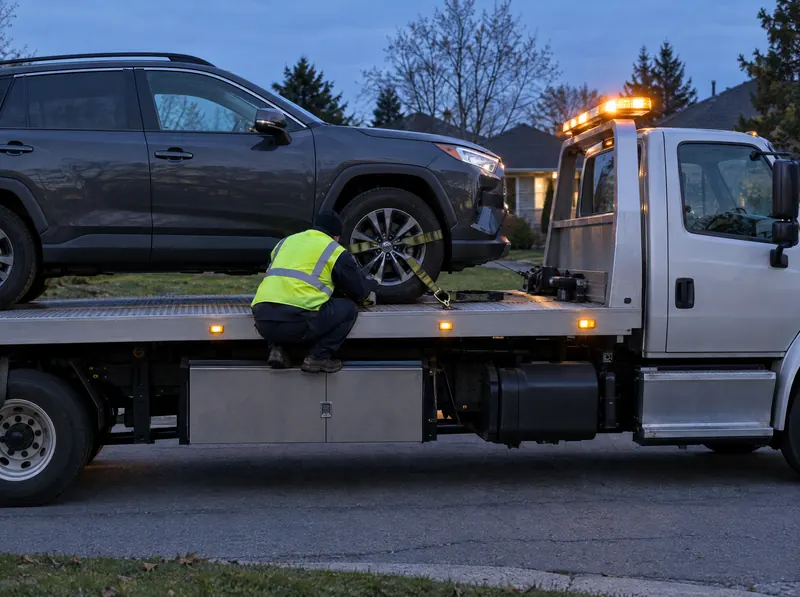
Near Dayton, Ohio, five things drive a tow price. Where the car stopped, such as an I-75 shoulder or an unplowed side street. How far it has to go, maybe across town from Huber Heights to Kettering. What went wrong. What you drive. And whether the truck has to pull it out of snow first. You get one price by text before anyone is sent, and you decide.
Why can't anyone quote a Dayton tow over the phone in one word?
Because "a tow" is many different jobs. Your car might click and die in a lot in the Oregon District. It might quit on a ramp at the Freedom Veterans Crossroads, where I-70 meets I-75 in Vandalia. Or it might slide into a snowbank on a side street in Dayton View.
Those calls need different trucks, different gear and different trips. So a fair price has to start with your facts. That's why the dispatcher asks so many questions. Every answer moves the number up or down.
This post won't give you a figure. A number on a web page can't see where your car is sitting. It can show you what moves the price, so you can give good answers and keep the job as small as it can be.
Does it matter which road I broke down on?
Yes. The road decides how hard the job is and how the truck gets to you.
Interstates and freeways
On I-75, I-70, I-675 or US 35, your driver works next to fast traffic. They need room to park behind you and load. Ohio's move-over law helps, since drivers must move over and slow down for any stopped vehicle with flashing lights, tow trucks included. But a narrow shoulder or a ramp still makes the job slower and harder.
Direction matters too. A truck coming from the wrong side may need to drive to the next exit and loop back. Tell the dispatcher which way you were headed and the last exit you passed. That keeps the trip short.
City streets and parking lots
A car in a flat, open lot is often the simplest job. A car wedged nose-in between two others, or deep in a parking garage, is harder. Low ceilings can keep a big truck out. If you're in a garage, say so up front, and say which level.
How much does distance change a tow around Dayton?
A lot. Distance is often the biggest piece of a tow. Greater Dayton spreads wide, from Brookville and Englewood in the west to Fairborn and Xenia in the east, and from Vandalia down to Miamisburg and Springboro.
Two trips count. The partner who takes your job first drives out to you. Then they haul your car to the shop. A short tow to a nearby shop is a smaller job than a run across the whole metro.
Here's a real choice you might face. Your car dies on I-675 near Beavercreek, but your usual mechanic is in Trotwood. That's a long haul across the area. A good shop closer to Beavercreek is a shorter trip. You can always move the car later, once you know what's wrong.
Not sure where to go? Ask. Pointing you to a good repair shop is part of the Stay-With-You Promise.
Near Wright-Patterson
SR 444 runs up to Fairborn and the Wright-Patterson Air Force Base gates. Off base, a truck can reach you like anywhere else. On base, access rules may apply. Tell the dispatcher exactly where you are, so they can tell you right away if a truck can get in.
Do I even need a tow, or just a jump?
This question can change the price more than anything else. A tow is the biggest job. Many calls turn out smaller.
- Car clicks or won't crank after a cold night? You may need a jump start, not a tow.
- Flat tire, and you have a good spare? A tire change gets you rolling on the spare.
- Stuck in snow or a ditch near the road, with no damage? A winch-out may be all it takes.
- Car runs rough, smokes, leaks or won't move at all? That's a car tow to a shop.
Describe what the car is doing, not what you think is broken. "It clicks once and the dash lights flicker" helps more than "the starter's bad." If a jump fixes it, you skipped a tow. If the battery won't hold a charge, the job changes, and you get a new price first.
Does my vehicle change the tow price?
It can. Sentinel handles light-duty jobs only: cars, SUVs, minivans and light pickups. Inside that group, some vehicles need more care.
- All-wheel drive cars usually ride on a flatbed with all four wheels off the ground.
- Cars sitting low to the ground need a gentle angle to load without scraping.
- A car that won't roll, with a locked wheel or brake, takes more work to get on the truck.
Give the year, make and model when you call. Mention anything odd, like a lowered car or a wheel that won't turn. That way, the right truck comes the first time.
How does Dayton snow change the job?
Snow turns simple jobs into bigger ones. NOAA's 1991 to 2020 normals for Dayton International show about 25 inches of snow a year and about 110 nights at or below freezing. January lows average near 22 degrees.
Which streets get plowed first?
The City of Dayton plows its roughly 1,700 lane-miles in order. First come highways and main roads, streets by schools and hospitals, and US 35 and SR 4 inside city limits. Next come secondary and collector streets. Residential streets get plowed and salted when snow totals reach 4 inches or more.
So after a lighter snow, your side street may not see a plow at all. Packed snow and ice can trap a car there. A truck may need to winch your car out to a cleared spot before it can tow it, or before you can drive off.
Why does street parking matter in a storm?
The city asks drivers to move cars out of parking lanes before a storm starts. One reason it gives: so your car doesn't get snowed in. On narrow streets there's no room to push snow to the middle, so plows push it to the side. A car parked there can end up buried.
Downtown, in bigger storms, crews may plow snow to the middle of the street where the parking meters are, then haul it away. If you can, park off the street before the snow falls. A car on a clear driveway is far easier to reach than one stuck in a wall of plowed snow.
What if Dayton police towed my car instead?
That's a different thing, and it's not a Sentinel job. Sentinel doesn't do impounds or police tows. The City of Dayton explains how to get your car back on its Towed Vehicle Information page.
If police towed your car after a crash, or for another reason that isn't a crime, the city page names the lot where you pick it up. If the tow was tied to a crime, you first need a release from the Dayton Police Auto Recovery Unit. It's in the Safety Building at 335 West Third Street, and the phone is 937-333-1058. Bring a title, registration or memorandum title, plus a photo ID.
Where Sentinel can help: if the released car won't start or isn't safe to drive, call us for a jump or a tow from the lot to your shop.
How does Sentinel set your Dayton price?
Sentinel Towing is a towing and roadside network, not a tow company. A vetted local partner tow company does the work. You tell us where the car is, what it's doing, what you drive and where it should go. We text your price before anyone is sent. That price is the most you pay for the job you described. If the job changes once your driver sees it, we text a new price first, and you choose.
After that, we check on you by text until the truck arrives. You get your driver's name, photo and truck, and you can track your truck on a map. For the roads and suburbs we cover, see our Dayton towing page. Check OHGO for crashes and work zones before you drive.
If anyone is hurt, or your car is stuck in a live lane, call 911 first. Sentinel is not an emergency service.
Stuck right now? Call 1-888-TOW-1213, or request help online.
Dayton Tow Price Questions
Why won't you post a Dayton tow price on the website?
Because each job sets its own price. The road, the distance, the problem and your vehicle all change it. Call or request help online, and you get one price by text before a truck is sent.
Is a tow off I-75 priced the same as one from my driveway?
Not always. A freeway shoulder or ramp is a harder place to work than a quiet driveway. The trip to the shop matters too. Tell the dispatcher exactly where you are, and the price will match the job.
My car is snowed in on a Dayton side street. Do I need a tow?
Maybe not. If the car runs fine and isn't damaged, a winch-out can pull it to a clear spot so you can drive away. Dayton plows residential streets once snow reaches 4 inches, so lighter snow can sit for a while.
Can the price go up after the driver gets there?
Not without your yes. The texted price is the most you pay for the job you described. If the job turns out different, we text a new price first, and you decide.
Rules change, so check the official source before you rely on it. Sources: City of Dayton Winter Weather Response, City of Dayton winter weather FAQs, City of Dayton Towed Vehicle Information, NOAA climate normals, ODOT Move Over, OHGO.