Safety
Hurricane Season Breakdowns Near Tallahassee: What to Do Before, During and After a Storm
If your car quits in Tallahassee during hurricane season, your first job is to get out of the flow of traffic. When a storm is coming, the I-10 shoulder west toward US 319 can turn into a travel lane, so it is no longer a safe place to stop. Take an exit if the car still rolls. Never drive into water you can't see through. If anyone is hurt or you're stuck in a live lane, call 911 first.
When is hurricane season in Tallahassee?
The Atlantic season runs from June 1 to November 30, per the National Hurricane Center. Storms can also form before or after those dates. So in early October, you are still in it.
Tallahassee has seen what a storm does to its roads. Hurricane Hermine hit the city in 2016. Hurricane Michael passed to the west in 2018. Both left huge parts of town in the dark. That means dark traffic lights, trees across lanes and lots of drivers on the move at once.
A breakdown on a normal Tuesday is a hassle. A breakdown the day before landfall is a different problem. Roads are packed. Shops are closed. Help has farther to go. You have less room for mistakes.
Why is the I-10 shoulder not safe during an evacuation?
Florida uses a plan called Emergency Shoulder Use during big hurricane evacuations. The Florida Department of Transportation lists I-10 westbound, from US 301 in Jacksonville to US 319 in Tallahassee, as one of its routes. US 319 meets I-10 at exit 203, at Thomasville Road and Capital Circle NE.
When the plan is on, most drivers may use the shoulder as a travel lane. Large trucks, buses and trailers may not. On a four-lane road, it's the right shoulder. On a six-lane road, it's the left one. Drivers get on and off the shoulder only where officers and signs show them.
Here is what that means for you. The strip you would normally pull onto may have cars on it at highway speed. Stopping there puts you in a lane.
What should you do if the car starts to fail on I-10 westbound?
- If the car still moves, keep going to the next exit. Pull into a lot, not onto the ramp.
- Turn your hazard lights on as soon as something feels wrong.
- If the car dies and you can't get off the road, stay buckled in your seat.
- If you're stopped where moving cars could hit you, call 911.
FDOT also tells shoulder drivers to slow down and watch for gutters, drains and spots where the shoulder narrows. A tire that drops into a drain inlet can bend a rim. Drive the shoulder slowly if you're told to use it.
What do you do at a dark traffic light?
Storms knock out power, and power runs the signals. Under Florida law, s. 316.1235, you must stop at a dark signal just as you would at a stop sign. That holds even if only some of the lights at that corner are out. Skipping the stop is a moving violation.
Big Capital Circle corners can get tense when the lights are out. Stop fully. Take turns. Watch for drivers who don't. And if your car stalls in the middle of a dark intersection, hazards on, stay put, and call 911 if traffic is still moving around you.
How deep is too deep to drive through?
Less than you think. The National Weather Service says 12 inches of rushing water can carry away most cars. Two feet can carry away SUVs and trucks. Six inches of fast water can knock over an adult. Over half of flood drownings happen when someone drives into floodwater.
In Tallahassee, low spots can flood fast in heavy rain. The Franklin Boulevard area by downtown and Killearn Lakes on the north side are two known trouble areas. Turn around and find another way. If water is rising around your car, get out and get to higher ground, then call 911.
Your car went through water and now it won't start. Now what?
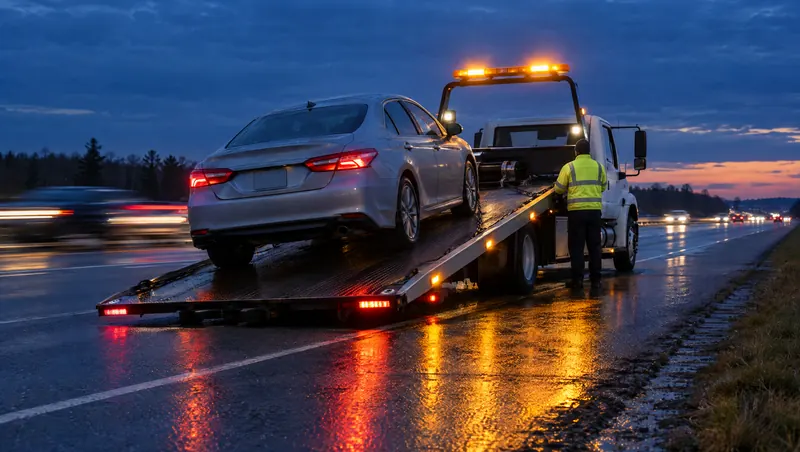
Don't keep turning the key. Water in the engine can turn a small problem into a big one. Get the car towed to a shop instead. A car tow on a flatbed keeps the wheels off the ground. If it just slid off a soft, wet shoulder and still runs, a winch-out may be all you need, once the area is safe.
What if a tree or power line is on your car?
Stay inside if a line is on or touching your car. Call 911. Tell anyone nearby to stay back. A tow partner cannot move a car that has live wires on it, and no one should try.
If a line is down across the road but not on you, back away and use another route. You can report downed lines to City of Tallahassee Utilities at 850-891-4968, any time, day or night. The city also has an outage map.
A tree on the car with no wires is a job for the fire department or a tree crew first. Your partner tow company moves cars, not trees. Once the tree is off, a tow can take it from there.
What can you do before the storm to avoid a breakdown?
- Fill the tank early, before everyone else does.
- Check your spare tire and your jack. A flat on a debris-covered road is common after a storm.
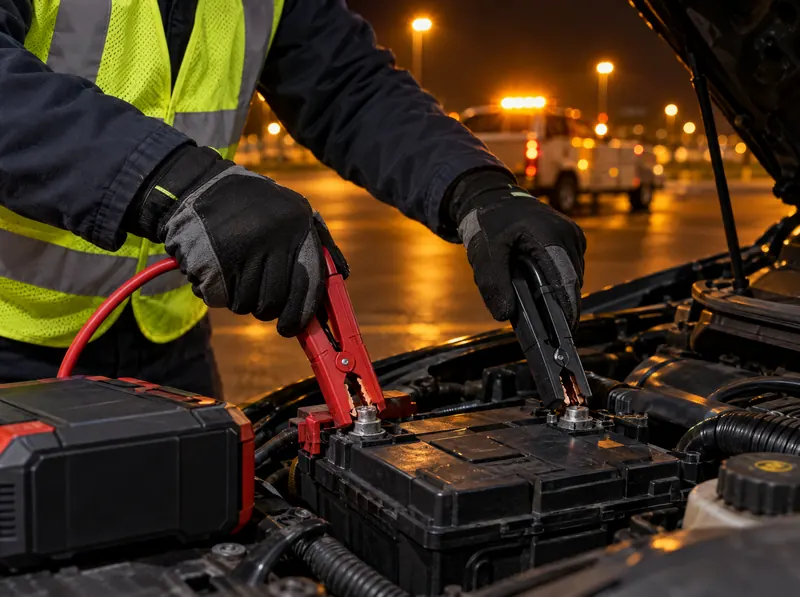
- Test your battery if it's been slow to crank. Heat and long idling in traffic are hard on a weak one. A jump start can get you moving, but a weak battery may quit again.
- Charge your phone and a backup battery pack.
- Get the Leon County Citizens Connect app. It shows a map of evacuation routes for Leon County if needed.
- Read the 2026 to 2027 Disaster Survival Guide at LeonReady.com.
Check FL511 before you leave for road closures and cameras. Leon County also posts updates on its Emergency Information Portal.
Is it safe to call for a tow right after the storm passes?
Yes, once the roads are open and the wind is down. Expect slow going. Canopy roads may still have limbs down. Work crews will be out. Florida's Move Over law covers wreckers on the roadside and disabled cars with hazards on, so drivers must move over or slow down for you.
When you call, give the cross street or the nearest exit. "I-10 westbound, just past exit 199" is far easier to find than "near Tallahassee." Tell the dispatcher if water or debris is around the car. That changes what kind of truck the job needs.
Sentinel Towing is a towing and roadside network, not a tow company. A vetted local partner tow company does the job. We lock your price by text before anyone drives out, and we keep checking on you by text until help arrives. That is the Stay-With-You Promise. You can also track your truck on a map. Read more about roadside help in Tallahassee.
Stuck right now? Call 1-888-TOW-1213, or request help online.
Tallahassee Hurricane Season Questions
Can I stop on the I-10 shoulder during a hurricane evacuation?
Try not to. During Emergency Shoulder Use, I-10 westbound from Jacksonville to US 319 in Tallahassee lets most cars drive on the shoulder. Take the next exit if you can. If you can't move and traffic is passing, call 911.
Who has the right of way when the lights are out after a storm?
Treat the corner like a stop sign. Florida law says to stop at a dark signal, even if only some lights are out. Then take turns with care.
Will a tow truck come if a power line is on my car?
No one should touch the car until the line is handled. Stay inside and call 911. Once the line is off and the area is clear, a partner can tow the car.
Does Sentinel tow flooded cars?
Yes, once the water is gone and the road is open. A partner can take a car that won't start to a shop. Nobody should wade into floodwater to reach a car.
Rules change, so check the official source before you rely on it. Sources: National Hurricane Center, FDOT Emergency Shoulder Use, Florida s. 316.1235, Florida s. 316.126, National Weather Service, City of Tallahassee Utilities, Leon County, FL511.