How-to
Dead Battery or Flat Tire Near Kelowna's Bennett Bridge? Here's What to Do
If your car starts to fail on the William R. Bennett Bridge in Kelowna, keep it moving if you can. B.C. law says not to stop on a bridge unless traffic or the law forces you to. Coast off the end, onto Harvey Avenue or the West Kelowna side. Find a side street or a lot, put your hazards on, and then call for a jump start, a spare tire change or a tow.
Why is the Bennett Bridge a bad place to stop?
The bridge is about 1,063 m long. The middle 700 m floats on Okanagan Lake. There is a fixed section at each end.
It carries five lanes of Highway 97. Three go west toward West Kelowna. Two go east into Kelowna. A concrete barrier runs down the middle. So if you stop, you can't swing across to the other side. Your partner tow company can't either.
Near the middle, the deck climbs a 6% grade to 18 m above the lake. That hump lets boats pass under. It also means a car that loses power on the way up slows down fast.
Traffic is the other problem. Congestion near the bridge is common, most of all southbound toward West Kelowna. A stalled car in one of those lanes backs things up in a hurry.
What does B.C. law say about stopping on a bridge?
Section 189 of the Motor Vehicle Act lists places you must not stop, stand or park. One of them is a bridge, or any other raised structure, on a highway. There is an exception. You may stop when it's needed to avoid conflict with traffic, or when the law, a police officer or a traffic sign or signal tells you to.
ICBC's driver guide says the same in plain words. If your engine fails, try to reach the nearest exit or a place to pull off. Avoid stopping on a bridge if at all possible.
What should I do the moment my car starts to die on the bridge?
- Don't panic-brake. If you have power steering, you can still steer after the engine quits. It just takes more muscle.
- Hazards on. Let the cars behind you know something is wrong.
- Coast as far as you can. Heading west, aim for the first safe spot past the end of the bridge. Heading east, aim for a side street or a lot off Harvey Avenue.
- Stop only if you must. If the car stops in a lane, stay inside with your seat belt on.
- Call 911 if you're stuck in a live lane or anyone is hurt. Sentinel is not an emergency service. Police can protect the scene.
Don't walk along the deck to look at the car. The bridge does have a 3 m sidewalk, but only on the south side. Crossing lanes of traffic to reach it is not worth the risk.
My battery died after I got off the bridge. Can I get a jump?
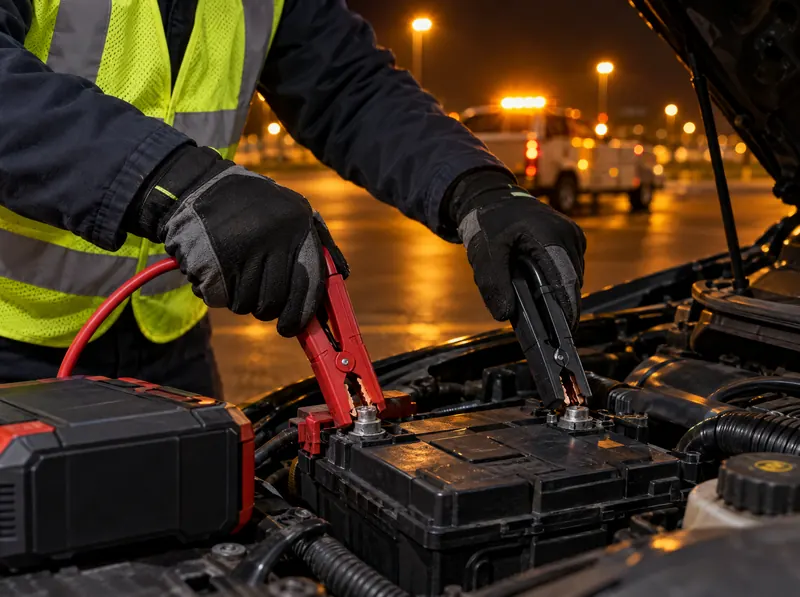
Yes. Once you're off the bridge and out of traffic, a dead battery is often a quick fix. A jump start is a common call in a parking lot along Harvey Avenue, or on a side street in West Kelowna.
Kelowna's weather is hard on batteries at both ends of the year. Environment Canada's normals for Kelowna's airport put the average January low at about minus 6 C. In summer, the same normals show about 26 days a year above 30 C. Cold makes a weak battery struggle to crank. Heat wears it out from the inside.
Here's how to tell what you're dealing with:
- Slow, tired crank, or a click. Most likely the battery. A jump may get you going.
- Dash lights fine, but nothing turns over. Could be the starter. A jump won't help much.
- It started, then died again on the road. The alternator may not be charging. That's usually a tow to a shop.
If the car dies a second time after a jump, don't try to make it across the lake again. Get it towed to a shop on your side of the bridge.
What if I get a flat tire on Highway 97 near the bridge?
A blowout at speed can pull the car hard to one side. ICBC's advice is simple:
- Keep a firm grip on the wheel.
- Don't brake hard. Ease off the gas and let the car slow down.
- Brake gently once you've lost some speed.
- Hazards on, then pull off the road when it's safe.
Driving slowly on a flat to get off the bridge is usually safer than stopping on it. You might ruin the rim. That's still better than a crash.
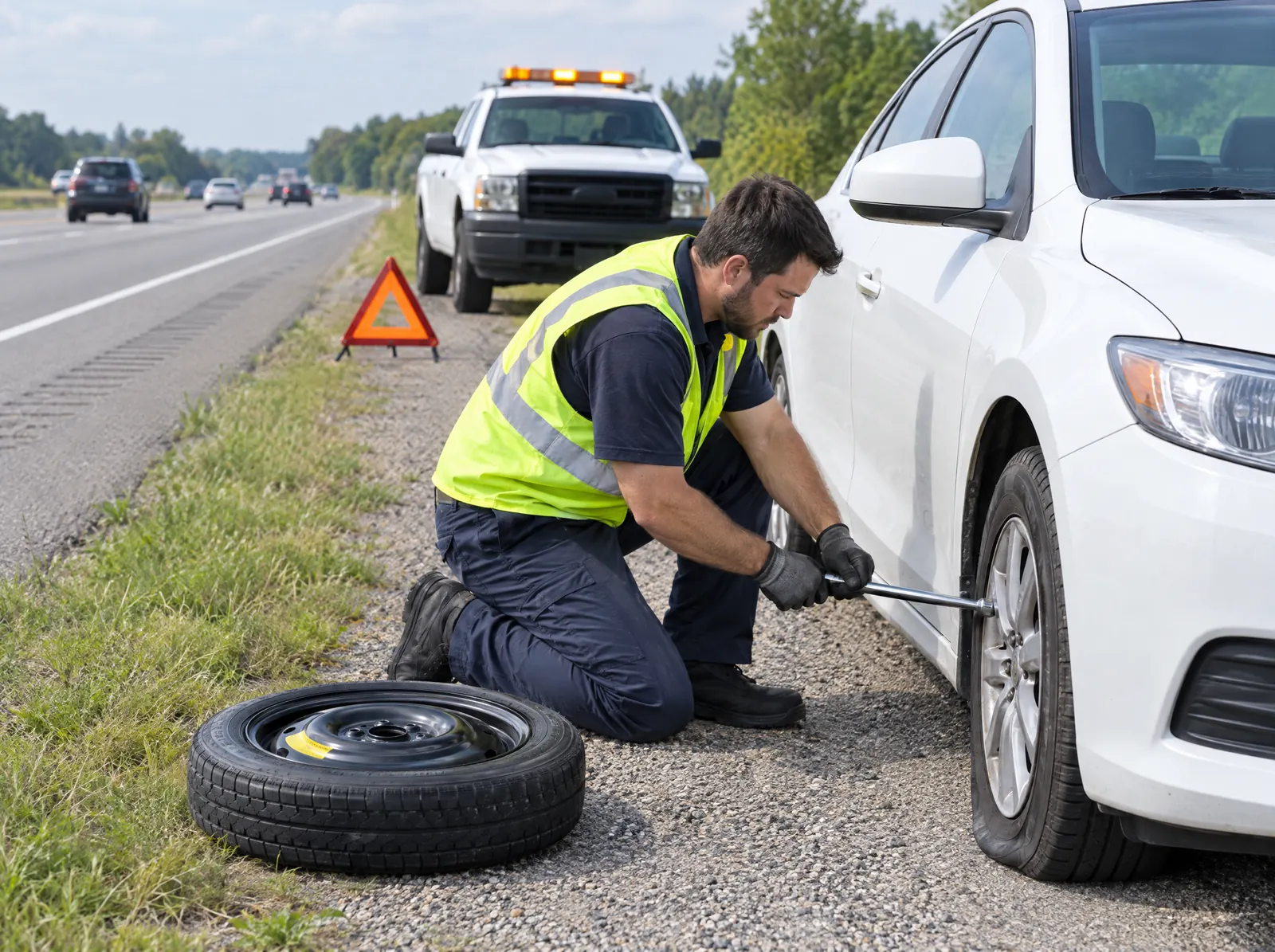
Never change a tire in a lane of Highway 97. ICBC tells drivers not to try roadside repairs on crowded, fast roads. Wait until you're on a quiet side street or in a lot. Then a flat tire change puts your spare on for you. If you don't have a good spare, the car needs a tow instead.
I pulled over and locked my keys inside. Now what?
It happens more than you'd think. You hop out to look at the tire, the door shuts, and the keys are on the seat. If the car is in a safe spot, a car lockout service can get you back in. If it's still running, tell us when you call.
Is there roadwork near the bridge right now?
Yes, on the West Kelowna side. DriveBC lists this work as of October 3, 2026:
| Where | When | What it means |
|---|---|---|
| Highway 97, Westlake Road to Westside Road | 9 p.m. to 6 a.m., in effect October 11 and 12 | Right lane and shoulder closed |
| Westside Road, Sailview Bay to Highway 97 | Weekdays, 8 a.m. to 5 p.m., until October 9 | Single lane, alternating; shoulder closed |
| Old Okanagan Highway, Shannon Lake Road to Byland Road and Daimler Drive | Until October 31 | Lane closures both ways |
"Shoulder closed" is the part that matters if your car is failing. There's no easy place to pull over inside those zones. If you can keep rolling, get past the cones before you stop. Then tell us whether you're before, inside or past the work zone. Your driver plans the approach around it.
Does fall weather make bridge breakdowns worse?
It can. Kelowna's airport sees about 12 fog days a year. Low winter cloud can also sit over the valley for days in December and January. On a gray morning, a stalled car on the bridge is hard to see. Keep your headlights and hazards on.
B.C.'s winter tire rules also started on October 1. Signed routes need winter tires or chains through April 30, and some end March 31. If you head up the Okanagan Connector from West Kelowna, check DriveBC first. A slide off a mountain road is a different job from a flat on the bridge.
What happens when the truck shows up?
Your driver will park with lights flashing. B.C. law requires other drivers to slow down for them. In a zone of 80 km/h or more, that means 70 km/h. Under 80, it's 40 km/h. Drivers must also move over a lane when it's safe.
Sentinel Towing is a towing and roadside network, not a local tow company. A vetted local partner does the work. When you call, tell us which way you were heading and which end of the bridge you made it to. We text your price before anyone is sent, and that price is locked. Then we stay with you by text until help arrives. You'll get your driver's name and photo, and you can track your truck on a map. That's our Stay-With-You Promise.
For the rest of the city, from Rutland to the Connector, see the Kelowna towing page. If your trouble is closer to Vernon, there's a Vernon page too.
Stuck right now? Call 1-888-TOW-1213, or request help online.
Kelowna Bridge Breakdown Questions
Can I get a ticket for stopping on the Bennett Bridge?
B.C.'s Motor Vehicle Act bans stopping on a bridge. It makes an exception when you must stop to avoid conflict with traffic, or when police or signs tell you to. The safest move is to keep rolling off the bridge if your car still can.
My car died on the bridge and won't move. Who do I call?
If you're stopped in a live lane, call 911 first. Stay in the car with your belt on and hazards on. Once police are there or you're safe, call us and we'll arrange the tow.
Should I walk to the sidewalk while I wait?
Usually not. The sidewalk is only on the south side, and a concrete barrier splits the lanes. Crossing traffic on foot is more dangerous than waiting in your car.
Can you tow my car across the bridge to a shop on the other side?
Yes. Tell us where the car is and which shop you want. You get one locked price by text for the whole trip before anyone is sent.
Rules change, so check the official source before you rely on it. Sources: B.C. Motor Vehicle Act, s. 189, ICBC Learn to Drive Smart, Open School BC: William R. Bennett Bridge, DriveBC: Highway 97 work, DriveBC: Westside Road work, DriveBC: Old Okanagan Highway work, B.C. winter tire routes, B.C. Slow Down, Move Over, Environment Canada climate normals.