How-to
Jump Start Help in Anchorage When the Cold Kills Your Battery
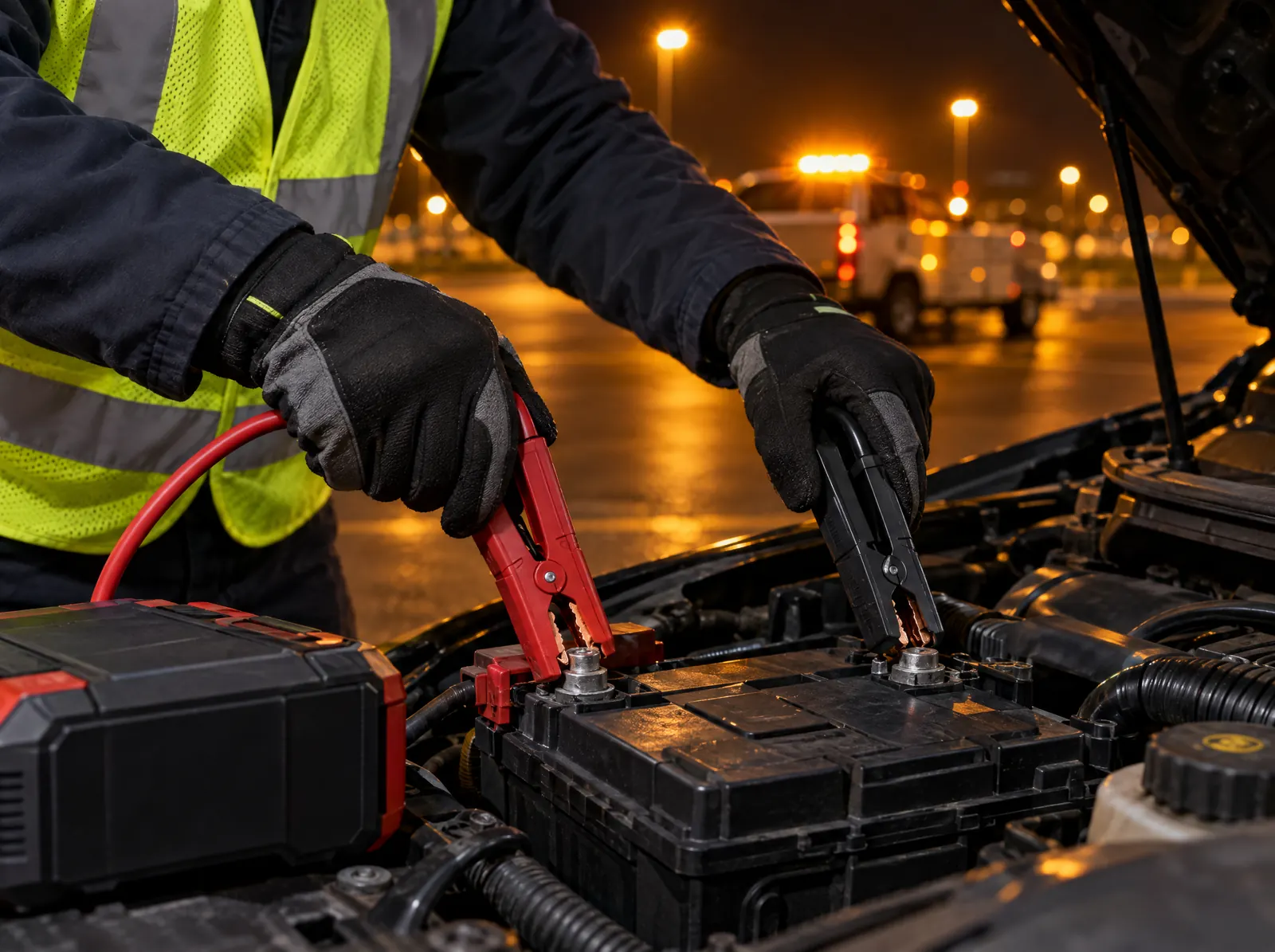
If your car won't start in Anchorage cold, turn off the lights, heater and radio, and stop trying to crank it. Then call for a jump start. A cold battery gives less power, and a cold engine is harder to turn. If you're on the Glenn or the Seward, keep your hazards on and stay buckled in. If the car starts, drive it a while. If it dies again, plan on a new battery or a tow to a shop.
Why do so many Anchorage batteries die on winter mornings?
It's the nights. NOAA's 1991 to 2020 normals for the Anchorage airport tell the story. In an average year, about 99 nights fall to 20°F or colder. About 20 of those drop to zero or below.
| Month | Average low | Nights at 10°F or colder | Nights at 0°F or colder |
|---|---|---|---|
| December | 13°F | About 12 | About 5 |
| January | 11°F | About 13 | About 7 |
| February | 14°F | About 10 | About 5 |
Your car sits through those nights in a driveway in Muldoon or a lot in Midtown. By morning the battery is cold and weak. The oil is thick. The National Weather Service says to have your battery checked before winter for this reason. A battery that seemed fine in September can quit on the first hard freeze.
What should you do the moment it won't start?
Listen to the car. The sound tells your driver a lot.
- Fast clicking, no crank. The battery is too weak to turn the engine. A jump often fixes this.
- Slow, heavy cranking. The battery is low and the engine is stiff from cold. Try once more at most, then call.
- Nothing at all, not even dash lights. It could be a dead battery or a loose cable. Say so on the call.
- It cranks fine but won't fire. That's likely not the battery. A jump may not help, so tell the dispatcher.
Next, cut every load you can. Lights, heater fan, seat heaters, phone charger. Each one pulls from a battery that has little left. Then call while there's still some charge. A battery that still clicks is easier to jump than one you've cranked flat.
What is Plug @ 20, and does it help your battery?
Plug @ 20 is a Municipality of Anchorage Health Department program. It asks you to plug in your engine heater when it's below 20 degrees. The city's goal is cleaner air. Its page says some of Anchorage's highest carbon monoxide levels show up on cold mornings, in quiet neighborhoods where lots of cars start cold after a night outside. Preheating an engine two to three hours before you start it cuts those fumes by nearly 60 percent, the city says.
It helps your car too. The city notes that cold oil moves slowly at startup. A warm engine turns over easier, so it asks less of a cold battery. Here's how to use the program well:
- Get the text alert. Text your zip code to 907-312-2014. The city texts you free when your zip code dips below 20 degrees.
- Check if you have a heater. A "cold weather package" on the window sticker can mean an engine heater and a heavy-duty battery. Look for a plug hanging from the grill.
- Use the right timer. The city says to look for "heavy-duty," "outdoor" and "block heater" on the box. Pick 15 amps or more with a 24-hour clock. Skip timers with a light sensor.
- Mount the timer high. Put it above 3 feet, so snow doesn't bury it.
Plug in even on mornings when the car starts fine. That's the city's own advice, and it keeps the weak morning from catching you off guard.
How do you wait safely if you're stuck on the Glenn or the Seward?
A no-start in a parking lot is a cold wait. A no-start on the shoulder near Eagle River, or on the Seward freeway by Tudor or Dowling, is a traffic risk too. If anyone is hurt, or your car is stuck in a live lane, call 911 first.
If you're on the shoulder and safe from traffic, the Weather Service has simple rules for waiting in winter:
- Stay in the car. Keep your belt on and hazards flashing while you can.
- Clear the tailpipe. Snow over the exhaust can push gas into the cabin. If you can't reach it safely, don't run the engine.
- Crack a window. Open it a little when the engine runs, to keep fresh air coming in.
- Run it in short bursts. If your car does start, run it for heat in short spells, not nonstop.
- Turn the dome light on at night. It helps your driver find you in the dark.
Out on Turnagain Arm, past the freeway, check Alaska 511 before you call. It's run by the state DOT&PF and shows closures. If the road is shut, no truck can reach you until it opens.
Does Alaska's move-over law protect the driver helping you?
Alaska Statute 28.35.185 names a tow truck picking up a vehicle with its lights flashing. Drivers on a road with two or more lanes going their way must leave the lane next to it. On a two-lane road, they must slow to a safe speed. So if your jump turns into a tow, the law covers your driver during hookup. It doesn't make the shoulder safe for you. Stay in your car until your driver tells you where to stand.
When is a jump start not enough?
A jump gets the engine running. It doesn't fix a battery that's worn out or a part that's failing. Watch for these signs after the jump:
- It dies again within the same day. The battery isn't holding a charge, or the car isn't charging it.
- The battery warning light stays on. The charging system may be the problem, not the battery.
- It won't start the next cold morning. Even plugged in, the battery may be too old for Anchorage winters.
If the car runs, drive it straight to a shop or parts store and have the battery tested. If it won't stay running, a tow to the shop you pick is the next step. And if you slid into a plow berm while it sputtered, a winch-out may come first.
How does a jump start through Sentinel work?
Sentinel Towing is a towing and roadside network, not a tow company. A vetted local partner near you does the jump start. Before anyone is sent, we text you a locked price. That price is the most you pay for the job. If the job changes, say a jump turns into a tow, you get a new price by text first, and you decide. Then we keep checking on you by text until the truck arrives. That's our Stay-With-You Promise.
When you call, give us three things. Where the car is, like "Midtown grocery lot, east side" or "Glenn northbound past the Eagle River exit." What it sounds like when you turn the key. And whether it's plugged in or parked nose-in to a snowbank. For the areas partners cover around town, see our Anchorage towing page.
Stuck right now? Call 1-888-TOW-1213, or request help online.
Anchorage Jump Start Questions
My car is plugged in and still won't start. Why?
The heater warms the engine, not the battery. An old battery can still fail. Check that the cord, outlet and timer are all working, too. If the car clicks, call for a jump and get the battery tested after.
Should I keep cranking to get it going?
No. Each try drains a battery that's already weak. Give it one more try at most, then turn everything off and call. A battery with a little charge left is easier to jump.
Can I sit in my running car while I wait?
Only if the tailpipe is clear of snow. The Weather Service says to run the motor in short spells and crack a window. If you can't clear the exhaust, keep the engine off and bundle up.
What if the jump works but the car dies again on the way home?
Pull over somewhere safe and call back. It likely needs a battery or a charging repair. We text you a tow price before anything is sent, and you decide.
Rules change, so check the official source before you rely on it. Sources: NOAA climate normals, Anchorage airport, Municipality of Anchorage: Plug @ 20, Municipality of Anchorage: Why Plug @ 20, National Weather Service: winter storm safety, National Weather Service: winter car preparedness, National Weather Service: vehicle safety, AS 28.35.185, Alaska 511.