Seasonal
Weekend Ski Traffic Near Kelowna's Big White: What to Know Before You Call
If your car quits in weekend ski traffic on Highway 33 between Kelowna and Big White, get as far off the road as you can, hazards on. Then call and say which way you were going and the last place you passed. Your tow truck has to climb the same snowy road, through the same line of cars. Plan to wait warm and buckled in. If you're stuck in a live lane or anyone is hurt, call 911 first.
Why is a breakdown on the way to Big White different?
Down in town, a dead car on Harvey Avenue is a short hop for a truck. Up on Highway 33, it's a mountain road. Highway 33 leaves Kelowna, climbs past Joe Rich and goes up the pass toward Big White. Then it carries on to Rock Creek.
The height change is the big thing. Environment Canada's Big White weather station sits at 1,841 meters. The Kelowna airport station sits at about 430 meters. That's about 1,400 meters of climb from the valley floor to the mountain.
So the weather you leave in town is not the weather you'll stop in. In town, a January day usually tops out near 1 C. Up top, it's a different winter. The province says the roads up there see fast-changing winter conditions, often when they're busiest. Ski weekends are exactly that.
Where does the ski traffic back up?
Most of it comes down to one turn and one hill. Big White Road leaves Highway 33 and climbs to Kettle Valley Road in Big White Village. Everyone heading to the resort makes that turn.
The province has called the Highway 33 grade near there "substantial." In 2012, it planned a 2.9 km southbound passing and truck climbing lane to cut the queues up that hill. The same plan gave the Big White Road junction a left turn bay, acceleration and deceleration lanes and lighting. There's also a brake check pullout south of the junction.
Highway 33 isn't only a ski road. It's also a truck route between Highway 97 and Highway 3. On a Saturday morning, you may share the climb with semis, ski buses and a long line of cars.
My car is dying in the ski line. What do I do?
If the car still moves, keep going to a wide spot. A pullout, the junction lanes or a lot is better than a snowbank shoulder. If it won't move, do this:
- Hazards on right away. Cars behind you are climbing and don't want to stop on a hill.
- Pull right as far as you safely can. Don't drive deep into soft snow. That turns a dead battery into a stuck car.
- Turn your headlights on by hand. The province says daytime running lights don't turn on your tail lights.
- Stay with your car. ICBC says to stay with your vehicle and never get into a stranger's car. If someone stops, ask them to drive on and call for you.
- Set out a triangle only if it's safe. ICBC says to use one when it's dark or hard to see. Never walk into the lane to place it.
Don't try to fix things in the lane. Ski traffic is impatient, and hills hide stopped cars.
How do I stay warm while I wait?
ICBC has plain advice for drivers stranded in snow. Stay with your vehicle unless you're sure you can reach help. If you run the engine for heat, do it for about five minutes every hour.
- Check the tailpipe first. Snow piled against it can push carbon monoxide into the car.
- Crack one window. ICBC says to keep one slightly open at all times.
- Keep one person awake. Drowsy or dizzy? Shut off the engine and get fresh air.
- Use your ski gear. Jackets, gloves, toques and blankets are already in the car. Put them on.
The province says to always carry an emergency kit and clothes for the weather. Ski days make that easy, since you're already packed for the cold.
What do I tell the dispatcher?
On a mountain road, "Highway 33" isn't enough. Your partner tow company needs to know which side of the hill you're on. Give your phone's map pin plus these:
- Up or down. Heading to the hill, or heading home to Kelowna.
- The last place you passed. Joe Rich, the Big White Road junction or the brake check pullout.
- Highway 33 or Big White Road. They are two different roads.
- What the car did. Won't start, flat, slid off or engine trouble.
- Your tires. Winter tires, all-seasons or chains. It helps your driver plan.
Which help do I need?
Match the problem to the call, so the right truck heads up the hill:
- Car won't start in the resort lot after a cold day. Ask for a jump start.
- Keys locked in the car with your boots and skis. That's a car lockout.
- Flat on the way up. If you have a good spare and a safe spot, a flat tire change may do it. The province says tire pressure drops as it gets colder, so check yours in town.
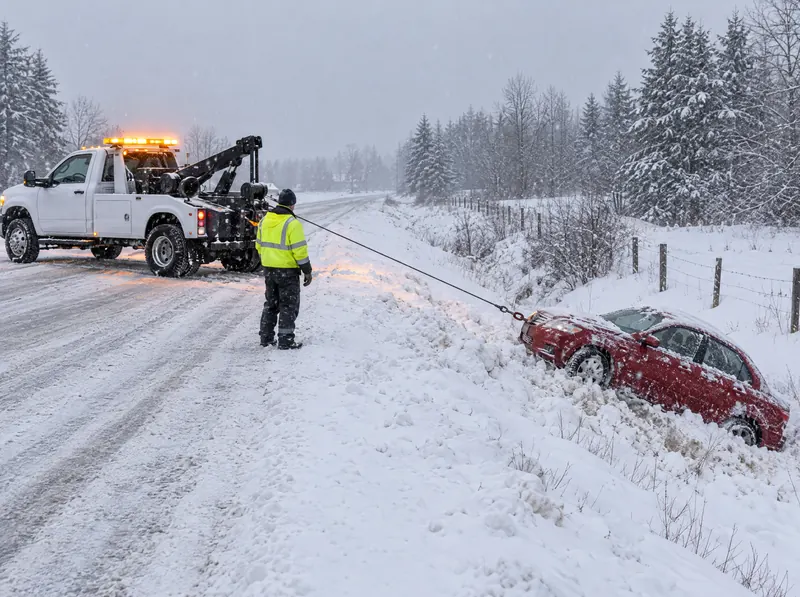
- Slid into the snowbank but not damaged. A winch-out pulls you back to the road, if you're close to it.
- Engine trouble, a crash or a car that can't be driven. Get a tow down to a shop in town.
We handle cars, SUVs, minivans and light pickups. We don't tow RVs or campers.
What do B.C. winter tire rules mean for the drive up?
From October 1 to April 30, B.C. drivers must obey winter tire and chain signs. Some lower routes end March 31. Police can turn you away and fine you. The RCMP may close a road to everyone if they think it's unsafe.
A legal winter tire has at least 3.5 mm of tread. It must show "M+S" or the 3-peaked mountain and snowflake symbol. You need at least two matching winter tires on the drive axle. Chains on summer tires don't count on signed highways.
The province also says ski hills, as private roads, may have their own tire and chain rules. Check before you go. If you need chains, ICBC says not to put them on while on a hill. Use a chain-up area instead.
Check DriveBC before you leave Kelowna, not at the wheel.
What happens when the truck gets there?
You get your driver's name, photo and truck by text before they arrive. You can follow the truck on a map as it climbs. On a busy ski road, that tells you when to get ready.
Drivers passing a tow truck with flashing lights must slow down in B.C. That's 70 km/h where the limit is 80 or more, and 40 km/h where it's lower. On two-lane stretches, they move over when it's safe. Many still won't. Stay off the road side of your car.
Who actually sends the truck?
Sentinel Towing is a towing and roadside network. We don't own trucks, and we have no Kelowna office. A vetted local partner tow company does the job. We text you a locked price before anyone is sent. Then we check on you by text until help arrives. That's the Stay-With-You Promise. For help down in the valley, see our Kelowna towing page.
Stuck right now? Call 1-888-TOW-1213, or request help online.
Big White Ski Traffic Questions
My car won't start in the Big White parking lot. Can you help?
Yes, if the car sits where a truck can reach it. Ask for a jump start and tell us which lot you're in. The resort may have its own rules for its lots and roads, so follow any staff directions.
Do I need winter tires to drive Highway 33 to Big White?
Where winter tire signs are posted, yes, from October 1 to April 30. A legal winter tire shows M+S or the mountain and snowflake symbol and has at least 3.5 mm of tread. Check DriveBC before you go.
Should I walk for help if I break down on the way up?
No. ICBC says to stay with your vehicle unless you're sure you can reach help. Call from the car, run the engine in short bursts and keep the tailpipe clear of snow.
Can you tow my car from the mountain to a shop in Kelowna?
Yes, for cars, SUVs, minivans and light pickups. Tell us where the car is and which shop you want. You get a locked price by text before a truck is sent.
Rules change, so check the official source before you rely on it. Sources: B.C. government, Highway 33 near Big White, Environment Canada station data, Big White, Environment Canada climate normals, Kelowna A, B.C. winter tire enforcement, B.C. winter tire rules, B.C. winter driving, ICBC emergency strategies, B.C. Slow Down, Move Over, DriveBC.