How-to
Winnipeg Drivers: What Actually Helps at the Roadside
Most Winnipeg roadside calls are small jobs: a dead battery, a flat tire or keys locked inside. Name the problem clearly, and a roadside helper can often get you moving without a tow. While you wait in the cold, stay in the car with the tailpipe clear. Manitoba law tells passing drivers to slow to 40 or 60 km/h and move over for the helper working beside your car.
Which roadside job do you actually need?
The fastest way to get the right help is to say what happened, not just "my car broke down." Each problem is a different job with a different tool. Here is how to tell them apart.
- The engine clicks or cranks slowly. That points to the battery. Ask for a jump start.
- The car pulls to one side, or the dash shows a tire light. Look at each tire. If one is flat and you have a good spare, ask for a flat tire change.
- The keys are on the seat and the doors are locked. That's a car lockout. No tow needed.
- The engine cranks hard but won't catch, or it's smoking or leaking. That's beyond a roadside fix. Plan on a tow to a shop.
If you're not sure, describe what you hear and see. "It clicks three times and the dome light is dim" tells a dispatcher more than "it won't go."
Will a jump start work on a minus 30 morning?
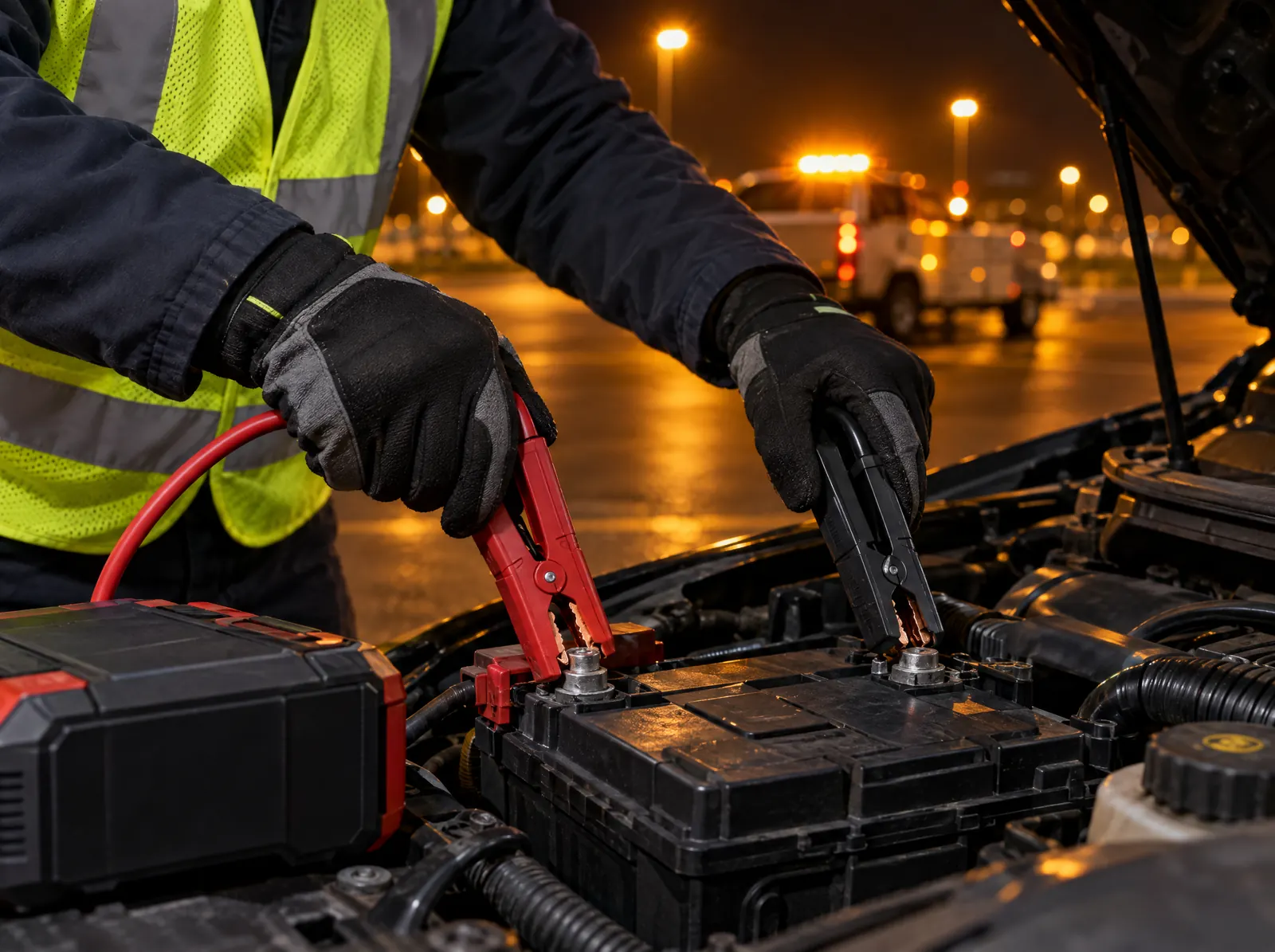
Often, yes. A battery that drained overnight in a Transcona driveway or the Polo Park lot usually takes a boost. Cold slows the chemistry inside a battery, so a weak one quits first on the coldest days.
Winnipeg sees a lot of those days. Environment Canada's 1981 to 2010 normals for Richardson International Airport show an average January low of about minus 21 C. Lows drop below minus 20 C on about 52 days a year.
A few things help the jump go well:
- Turn off the heater fan, the lights and the radio before the boost.
- Once it starts, let it run. Drive for a while if you can, so the battery can charge.
- If the car dies again within a day, the battery or the charging system is failing. A second jump only buys time. A tow to a shop is the better call.
The Winnipeg Police Service tells drivers to carry booster cables in a winter kit, along with warm gloves, blankets and safety pylons. Cables help if a friend is close by. If nobody is, call for help instead of flagging down strangers on Bishop Grandin.
Why do tires go flat when it gets cold?
Some don't go flat at all. They just go low. Transport Canada says tires lose about 1 psi (7 kPa) for every 5 C drop in air temperature. A tire set on a warm October afternoon can read well under spec by a January morning.
So check before you call. Look for a nail, a gash or a tire sitting right on the rim. A tire that's just soft may only need air at a gas station. A real flat needs your spare put on.
Your correct pressure is on the tire information label. Transport Canada says it's usually on the edge of the driver's door, the door post, the glove box or the fuel door. Check the spare too. A flat spare in the trunk is a common surprise, and then the job turns into a tow.
A roadside helper puts your spare on. They don't patch or repair the tire. Get the flat fixed or replaced soon after, and check your owner's manual for any limits on the spare.
Can I leave my car running to warm it up?
Manitoba's Highway Traffic Act says you must stop the engine, lock the ignition and take the key before you leave a car unattended on a highway. It makes room for one case: running the engine for a short time to warm the car and defrost the windshield in frigid weather.
Legal is not the same as smart. The Winnipeg Police Service says to never leave keys in an unattended vehicle. Its advice is a remote starter, so the car warms up while it stays locked.
There's a roadside angle too. Warm-ups and quick stops are when keys get left behind. Step out to scrape the windshield, bump the lock, and you may be staring at your keys through the glass. Keep a spare key in your wallet or at home, not in the car. If it happens anyway, a lockout call gets you back in.
How do you wait warm until help gets there?
The wind is the danger, not just the thermometer. The same airport normals show a wind chill below minus 30 on about 44 days a year. Environment Canada says at a wind chill of minus 28 to minus 39, exposed skin can freeze after 10 to 30 minutes outside. At minus 40 to minus 47, it can freeze after just 5 to 10 minutes.
Public Safety Canada's winter storm advice is simple: if you're trapped, stay inside your vehicle and keep the tailpipe clear of snow and ice. A blocked tailpipe can push exhaust into the car.
- Stay in your seat with your belt on and hazards flashing.
- If you run the engine for heat, check that the tailpipe is clear first. Snow piles up fast behind a car in a drift.
- Put on your hat and gloves now, before you need them.
- Keep your phone warm in an inside pocket. Cold drains phone batteries too.
- If anyone is hurt, or your car is stuck in a live lane, call 911 first.
What does Manitoba's move-over law mean for you?
Manitoba's Highway Traffic Act counts roadside helpers as designated vehicles. That includes tow trucks and vehicles doing battery service, tire changes and lockouts. When one is stopped with its lights on, passing drivers must slow down.
- No more than 40 km/h where the limit is more than 40 and up to 79 km/h.
- No more than 60 km/h where the limit is 80 km/h or more.
- Stay at that speed until you've passed, and pass only when it's safe.
- With two or more lanes going your way, move to a lane farther away if you safely can.
One detail surprises people. The rule doesn't apply to drivers on the other side of a divided highway. On a divided road like the Perimeter (PTH 100 and 101), traffic in the far lanes keeps its normal speed. That's one more reason to stay in your car on the side away from passing traffic.
What should you tell the dispatcher?
Winnipeg is flat and the big roads look alike in blowing snow. Be specific so your helper finds you on the first pass.
- The road and direction. "Pembina Highway southbound past Bishop Grandin," not just "Pembina."
- A landmark. A gas station, a mall entrance, an exit sign.
- The job. Battery, flat, lockout or tow, with what you see and hear.
- Your car. Make, model and color. Say if you have a spare.
Heading out of town? Check Manitoba 511 first. It's the road condition service run by Manitoba Transportation.
Car gone from the street overnight?
Before you call anyone about a stolen car, think about where you parked. The City of Winnipeg can start a winter route parking ban any time from November 1 to the end of April. It announces the ban seven days ahead. Once it's on, cars parked on designated winter routes between 2 a.m. and 7 a.m. risk a ticket and a tow. In an extended ban, the cutoff moves up to midnight.
Sentinel doesn't do impounds or parking ban tows, and can't release a car from a compound. Start with the city. If the car won't start once you get it back, a jump or a tow to a shop is a job we can help with.
How does Sentinel handle a roadside call?
Sentinel Towing is a towing and roadside network, not a tow company. A vetted local partner does the jump, the tire change, the lockout or the tow. We text you a locked price before anyone is sent. Then we stay with you by text until your helper pulls up, with their name, photo and truck, and a map to track your truck. That's the Stay-With-You Promise. For roads and neighborhoods across the city, see the Winnipeg towing page.
Stuck right now? Call 1-888-TOW-1213, or request help online.
Winnipeg Roadside Questions
My battery died in a parking lot at minus 35. Is it dead for good?
Not always. Deep cold makes a weak battery quit, and a jump often gets it going. If it dies again within a day, the battery or charging system needs a shop.
My tire light came on during a cold snap, but the tire looks fine. Do I need help?
Maybe not. Tires lose about 1 psi for every 5 C drop, so a cold morning can trip the light. Add air to the pressure on your door label. If the tire keeps losing air or is on the rim, call for a spare change.
Can you fix my flat instead of putting on the spare?
No. A roadside helper puts your spare on, but doesn't patch or repair tires. If you have no usable spare, the next step is a tow to a tire shop.
Should I get out and wave down the helper when they arrive?
Stay in the car until the truck is parked and the driver comes to you. You'll get the driver's name, photo and truck by text, so you know who to expect.
Rules change, so check the official source before you rely on it. Sources: Manitoba Highway Traffic Act, s. 109.1 and 221, Winnipeg Police: warming up your car, Winnipeg Police: winter driving safety, Transport Canada: inflating your tires, Public Safety Canada: winter storms, Environment Canada: wind chill, Environment Canada climate normals, Winnipeg airport, City of Winnipeg: winter parking bans, Manitoba 511.