How-to
Roadside Assistance in Tucson: Heat, Flats and Dead Batteries
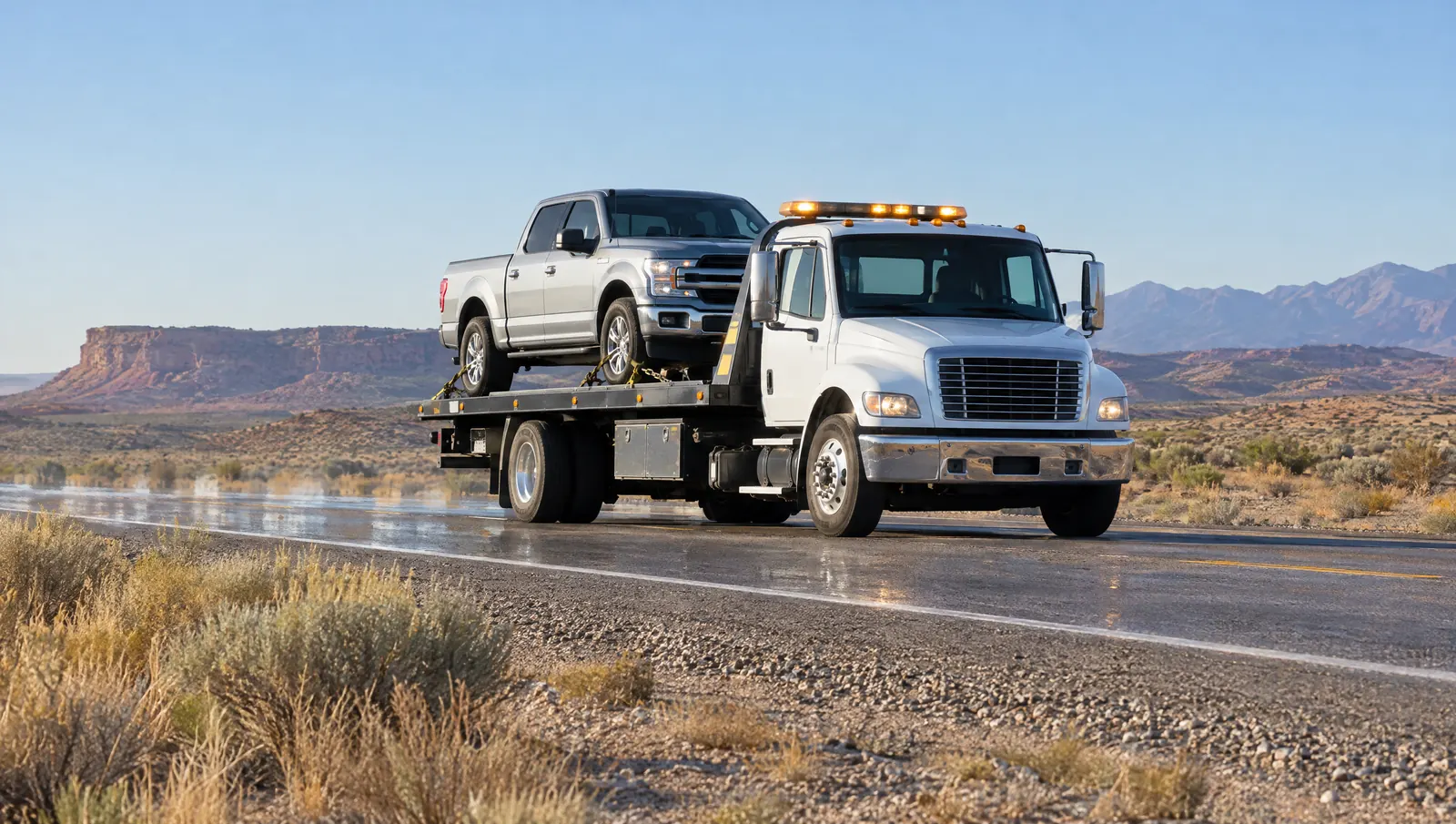
In Tucson, most roadside calls come down to heat: a battery that won't crank after a day in the sun, a tire that lets go on hot pavement, or a tank that runs dry on I-10. Call, tell us the problem and your spot, and get your price by text before anyone is sent. While you wait, your first job is staying cool. If anyone feels sick from the heat, call 911.
Why does Tucson heat cause so many breakdowns?
Tucson summers are long. NOAA's 1991 to 2020 normals for the airport put the average June high at about 101 degrees. July sits near 100, and August near 99. Even September averages about 95, and October still reaches about 86.
The nights don't give your car much of a break either. The normal July low at the airport is about 76. So a car parked outside never really cools off between trips.
Heat works on a car in three main ways:
- Batteries: heat is hard on them. A weak battery can work fine in the morning, then quit after an afternoon in a sunny lot.
- Tires: a tire that is low on air or worn thin runs hotter on long trips. Hot pavement adds to it.
- Cooling and rubber parts: old hoses and belts crack. An engine that runs hot may need a tow, not a quick fix.
Which roadside problem do I have?
Tell the dispatcher what the car did, not what you think broke. These clues point to the right help.
| What happened | What it usually needs |
|---|---|
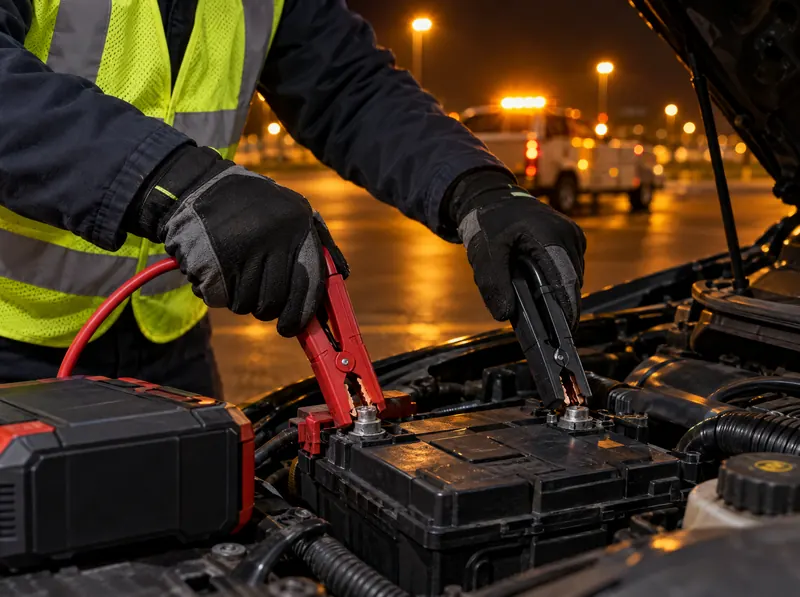
| A click, or a slow crank, and dim dash lights | Jump start |
| A loud bang, then the car pulls hard to one side | Flat tire change to your spare |
| The engine sputtered and the gauge reads empty | Fuel delivery |
| Temperature gauge in the red, or steam from the hood | A tow to a shop |
| Strong crank, but the engine won't catch | A tow to a shop |
If a jump gets you going but the car dies again the next day, the battery is likely done. Your driver can't sell or install one. Drive straight to a parts store or shop while it runs.
What should I do while I wait in Tucson heat?
This is the part that matters most. A stalled car in the sun heats up fast. The National Weather Service says a parked car can reach dangerous heat even on a mild day in the 70s. Cracking the windows doesn't slow it much. A dark dashboard or seat can hit 180 to over 200 degrees.
If the engine still runs
Keep the AC on and stay inside, belted in, if you're on a shoulder. Watch the temperature gauge. If it climbs toward red, shut the engine off and move to the next plan.
If the engine is dead
- On a city street or in a lot, get out and find shade or air conditioning. A store, a gas station or a bus shelter works.
- On the shoulder of I-10 or I-19, stay well away from traffic. Stand behind the guardrail if there is one. Never stand between your car and the lanes.
- Drink water even if you don't feel thirsty. The Weather Service gives that same advice for hot days.
- Never leave a child or a pet in the car, not even for a minute.
We text you your driver's name, photo and truck. You can also track your truck on a map. That means you can wait in the shade of a store and still walk out when the truck pulls in.
Know the signs of heat illness
The Weather Service lists heavy sweating, weakness, cool and clammy skin, dizziness, nausea and headache as signs of heat exhaustion. Get somewhere cool and sip water. Confusion, slurred speech, or hot red skin can mean heat stroke. That is a medical emergency. Call 911 right away.
Where should I stop if the car starts to fail?
Arizona law gives you a clear order of choices.
On a highway outside a town or neighborhood, A.R.S. 28-871 says not to stop on the traveled lanes if you can get off them. Other drivers also need a clear view of your car from 200 feet each way. The law makes an exception if the car is so disabled that you can't avoid stopping where it is.
On a freeway like I-10, A.R.S. 28-873 bans stopping except for emergencies or in spots like rest areas. A breakdown counts. The same law bans stopping on a bridge. So if the car still rolls, coast past the bridge or overpass, then pull as far right as you can.
In town, the best spot is usually a side street or a parking lot. A stall on Speedway at rush hour is much safer once you're around the corner.
Hazards on, and let the law work for you
Turn your hazard lights on the moment you slow down. Under A.R.S. 28-775, drivers coming up on a stopped vehicle with flashing or warning lights must move over a lane when they can. If they can't, they must slow down. That covers your car and your driver's truck. Still, don't count on every driver to do it. If you're stuck in a live lane or anyone is hurt, call 911 first. Sentinel is not an emergency service.
How do I tell the dispatcher where I am in Tucson?
Tucson has few freeways and many long, straight streets that look alike. A good location saves a lot of back and forth.
- On I-19: read the number on the nearest kilometer post. This road uses kilometers, not miles.
- On I-10: give your direction, toward Phoenix or toward the east side, plus the last exit you passed.
- On SR 210: say whether you're closer to downtown or to the Davis-Monthan end.
- On a city street: give the street and the nearest cross street, like Broadway at Swan or Oracle near Tucson Mall.
- In a big lot: name the store you're parked nearest, and the row if you can see one.
When the text comes in, share your map pin too. It removes all doubt.
What about running out of gas on a desert drive?
Lots of Tucson trips leave the city: up I-10 toward Phoenix, or down I-19 through Green Valley. On those runs, AC at full blast and a long climb burn more fuel than you expect. Fill up before you leave the metro, not after the light comes on.
If you do run dry on the freeway, stay with the car. Walking a hot shoulder to the next exit is dangerous in traffic and in the sun. Ask for fuel delivery and give the exit or kilometer post. Tell us the make and model, and whether it takes diesel.
How do monsoon storms change things?
Rain in Tucson is rare most of the year. Then July hits. NOAA normals show the airport gets about 2.2 inches of rain in July, compared with about a quarter inch in June. Those storms come fast, often in the afternoon.
- Flooded street: turn around. The Weather Service says 12 inches of rushing water can carry away most cars. Under A.R.S. 28-910, driving around a barricade onto a flooded road can make you pay for the rescue.
- Dust storm: the Weather Service says to pull off the pavement as far as you can, turn your lights off, set the brake and take your foot off the brake pedal.
- Stalled after the storm: once the water is gone and you're on dry ground, a tow or a winch-out near the road can help.
Check closures on AZ 511 before a drive on a storm day.
Who comes out when I call?
Sentinel Towing is a towing and roadside network. We don't own trucks. A vetted local partner tow company does the job. We lock your price by text first, and we check on you by text until help arrives. That's our Stay-With-You Promise. Your price depends on the job, your vehicle and where it sits. If the job changes once your driver sees the car, you get a new price by text first, and you decide.
For the full picture of towing across the metro, from Marana to Vail, see our Tucson towing page.
Stuck right now? Call 1-888-TOW-1213, or request help online.
Tucson Roadside Questions
Does Tucson's winter cause roadside problems too?
Less often, but yes. NOAA normals put January lows at the airport near 41, with about 12 nights a year at or below freezing. A battery that the summer wore down can fail on one of those cold mornings. A jump start often gets you going.
My tire blew on hot pavement and I have no spare. Can you fix it?
Your driver can only put on a spare you already have. Tire repair isn't part of the service. With no spare, ask for a tow to a tire shop. You get that price by text before anyone is sent.
Can I wait in a store instead of next to my car?
Yes, and in the heat that is often smarter. Lock the car and keep your phone on. You get your driver's name, photo and truck by text, and you can follow the truck on a map.
My keys are locked in the car with my child inside. Who do I call?
Call 911 first. The Weather Service warns that a parked car can get dangerously hot even on mild days. For a lockout with no one trapped inside, a car lockout visit can open the door.
Rules change, so check the official source before you rely on it. Sources: NOAA monthly climate normals, Tucson, NOAA annual climate normals, Tucson, NWS heat safety, NWS heat illness, NWS flood safety, NWS dust storm safety, A.R.S. 28-871, A.R.S. 28-873, A.R.S. 28-775, A.R.S. 28-910, AZ 511.