How-to
Jump Start in Wichita: What to Do When Your Battery Dies
If your battery dies in Wichita, first get the car out of traffic or stay buckled in if you can't. Then listen when you turn the key. A slow crank or rapid clicking usually means a flat battery, and a jump often fixes it. No sound at all, or a car that dies again right after, points to a bad battery, cable or alternator. That needs a new battery or a tow to a shop.
Why do batteries die so often in Wichita?
Wichita hits a battery from both sides of the calendar. Summer is long and hot. NOAA's 1991 to 2020 normals for Wichita's official weather station count about 65 days a year at 90 degrees or more. About 12 of those days reach 100. July's normal high is about 93, and August sits near 91.
Heat wears a battery down without warning signs. You don't notice it in August. You notice it on the first cold morning in November, when a tired battery finally can't turn the engine over.
Winter nights here get cold enough to finish the job. The same NOAA station averages about 103 nights a year at or below freezing. About 32 nights drop to 20 degrees or lower, and about 8 reach 10 or lower. January's normal low is about 22.
The U.S. Department of Energy's fuel economy site says battery performance drops in cold weather. It also says the cold makes it harder for your alternator to keep the battery charged. So a weak battery that got by all summer often quits after the first real cold snap.
Is it the battery, or something else?
Before anyone hooks up cables, spend one minute on the signs. They tell you whether a jump is worth trying.
| What you notice | What it usually means |
|---|---|
| Slow, lazy crank that won't catch | Low battery. A jump often works. |
| Fast clicking, dash lights flicker | Battery too weak to crank. Try a jump. |
| One loud click, then nothing | Could be the starter or a loose cable. A jump may not help. |
| No lights, no sound at all | Very dead battery or a bad connection at the posts. |
| Starts after a jump, dies a few miles later | The charging system may be failing. Plan on a shop. |
| Engine cranks strong but won't fire | Not a battery problem. Think fuel or ignition. |
Pop the hood and look at the battery posts. White or green crust on the clamps can block the current. A loose clamp can too. If a clamp wiggles by hand, tell your driver when they arrive.
Check the easy stuff first. Is the car in park? Is your foot on the brake? A push-button car may also need the key fob held close to the button when the fob battery is low.
How do I jump start a car safely?
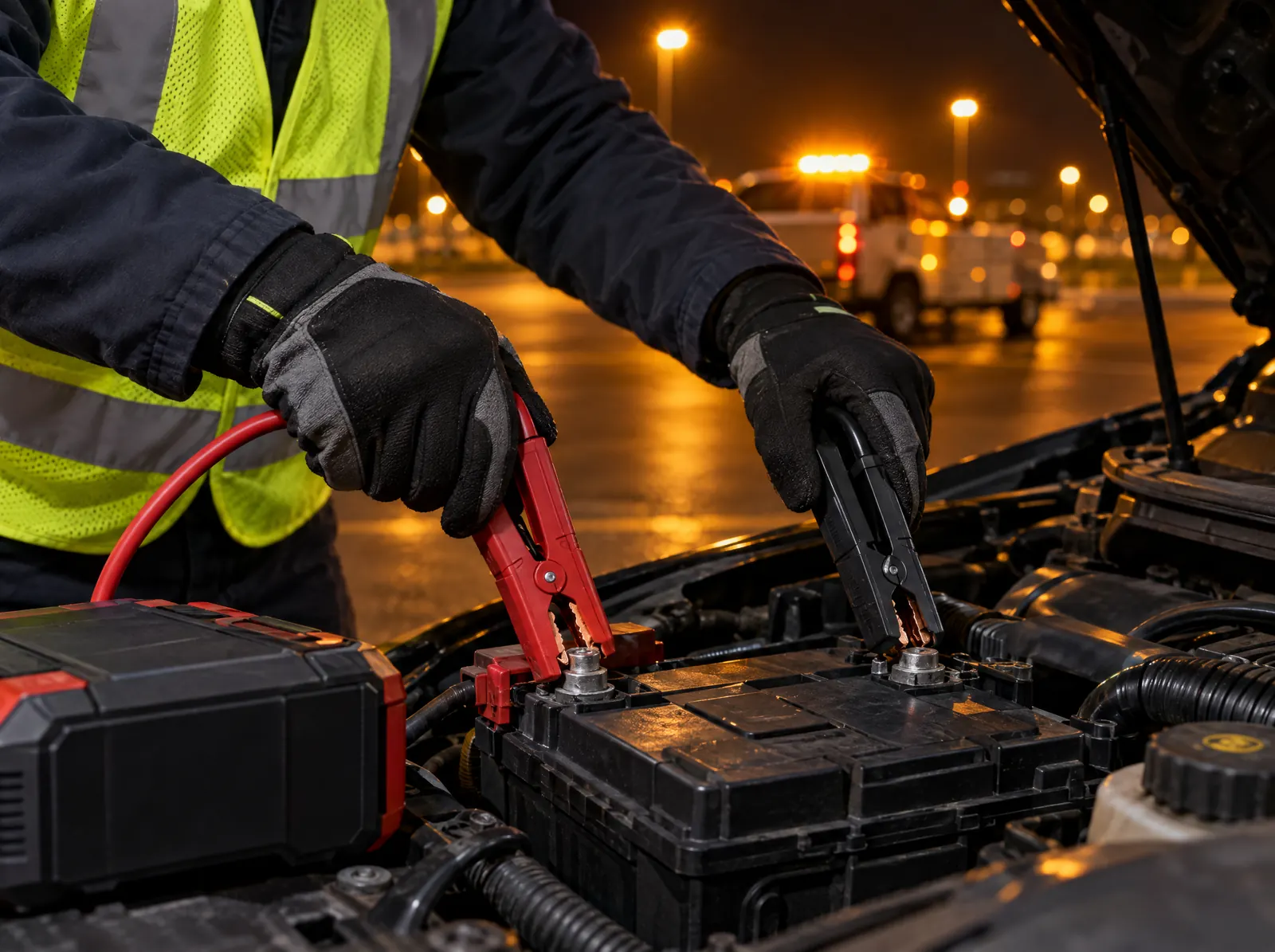
If a friend with a working car is there and you both feel sure, here is the safe order. Your owner's manual comes first if it says something different. Some cars have remote jump points under the hood instead of bare battery posts.
- Park the good car close, but don't let the two cars touch. Turn both engines off.
- Put both cars in park with the parking brake on. Turn off lights, radio and fan.
- Clip one red clamp to the dead battery's positive (+) post.
- Clip the other red clamp to the good battery's positive (+) post.
- Clip one black clamp to the good battery's negative (-) post.
- Clip the last black clamp to bare, unpainted metal on the dead car's engine, away from the battery.
- Start the good car. Let it run for a bit.
- Try the dead car. If it starts, take the clamps off in reverse order.
Stop if you see a cracked or swollen battery case, smell rotten eggs or see fluid leaking. Don't jump a frozen battery. Keep sparks and flames away, and never let the clamps touch each other. If any of that shows up, a tow is the safer move.
What if there's no one to give me a jump?
That's what a roadside jump start is for. Your driver brings the equipment and hooks it up. If the car won't take the jump, they can tell you that on the spot.
Where does a dead battery strand you in Wichita?
Where you are changes what you should do while you wait.
In a parking lot
This is the easy case. Your battery dies in an Old Town lot after dinner, or in a College Hill driveway on a cold January morning. You're off the road. Stay with the car, lock the doors and wait. Give the exact lot, the row and your car's color when you call.
At a light on Kellogg or Broadway
Kellogg Avenue carries US 54 and US 400 across the city. Broadway carries US 81 in from the south. If the car quits at a light, turn on your hazard lights right away. If you can roll it into a lot or side street, do. If you can't, stay buckled in. Don't stand between cars.
On I-135, I-235 or the Turnpike
A dead car on a freeway is a different problem. I-135 has a flood canal between its lanes through the middle of the city, so never try to cross on foot. On any highway, flashers go on first. Stay in the car with your belt on unless it's on fire or you're in real danger. If you're stopped in a live lane, or anyone is hurt, call 911 first.
The Kansas Highway Patrol says you can reach a KHP dispatcher from a cell phone at *47. On the Kansas Turnpike, which is I-35 along Wichita's southeast side, dial *582. For road conditions, KHP lists 511, and KDOT runs the KanDrive map.
Kansas has a move-over law, K.S.A. 8-1530. It tells drivers to change lanes away from a stopped emergency vehicle with its lights on, when there are two lanes and it's safe. If they can't, they slow down. The law doesn't name tow trucks, so never count on traffic giving your driver room.
When does a jump start not fix it?
A jump gets a car running. It doesn't fix a battery that's worn out. Here's when to skip the second jump and get the car to a shop:
- The car needed a jump yesterday, and it needs another today.
- It starts, then dies within a few miles.
- The battery warning light stays on while you drive.
- The case is bulging, cracked or leaking.
- The engine cranks fine but still won't start.
In those cases, a tow to a repair shop is usually the right call. Tell the dispatcher which shop, or ask for help finding one. If you're on the edge of town in Derby, Andover or Maize, say so. The distance to the shop is part of the job.
Ready.gov suggests having a mechanic check your battery and ignition system before trouble hits. Fall is a good time in Wichita, before the first hard freeze. KHP and Ready.gov both list jumper cables for your car kit, along with a flashlight.
What happens when I call Sentinel for a jump?
Sentinel is a roadside network, not a tow company, and owns no trucks. A vetted local partner tow company does the jump. You get your price by text before anyone is sent, and that price is the most you pay for the job. If the jump doesn't work and you need a tow, we text a new price first and you decide.
You get your driver's name, photo and truck by text. You can track your truck on a map. We check on you by text until help arrives. That's our Stay-With-You Promise. For roads and areas we cover, see the Wichita towing page.
When you call, have this ready:
- Where you are: the lot and row, or the highway, direction and nearest exit.
- What the car did: slow crank, clicking or nothing.
- Your car's make, model and color.
- Whether it's in a garage or a tight spot a truck can't reach.
Stuck right now? Call 1-888-TOW-1213, or request help online.
Wichita Jump Start Questions
My car clicks but won't start in the cold. Is it the battery?
Fast clicking on a cold morning usually means a weak battery. Wichita's January lows average about 22 degrees, and cold cuts battery power. A jump often gets it going. If it keeps happening, have the battery tested.
Can I get a jump on the Kansas Turnpike near Wichita?
Call and give your direction and the nearest exit. If a partner covers your stretch, we text your price and send them. If you're in danger, call 911. KHP lists *582 for help on the Turnpike.
Why did my battery die in the fall when it was fine all summer?
Wichita's long hot summers can wear a battery down without any signs. The first cold nights then ask more of it. The Department of Energy notes that battery performance drops in the cold.
What if the jump doesn't work?
Your driver can tell you if the car won't take a charge. Then a tow to a shop is the next step. We text you the new price first, and you decide.
Rules change, so check the official source before you rely on it. Sources: NOAA climate normals, Wichita, FuelEconomy.gov: cold weather, Ready.gov: car safety, Kansas Highway Patrol: winter driving tips, K.S.A. 8-1530, KanDrive.