How-to
Roadside Help on Oahu's H-1 or the Pali Highway: What to Do Where You Stopped
If your car quits on the H-1 in Honolulu, get as far right as you can, turn on your flashers and stay buckled in. On weekdays from 5 a.m. to 7 p.m., the state's free Freeway Service Patrol covers most of the H-1. The Pali Highway is not on its route. There, and on the H-1 after hours, the state says to call 911. Once your car is off the road, you choose who fixes or tows it.
Which part of Oahu's freeways does the free patrol cover?
The Hawaii Department of Transportation runs the Freeway Service Patrol. It costs you nothing. The trucks carry the patrol's name and the state DOT seal on the side.
The patrol works both directions on these roads:
- The H-1 from Makakilo Drive to Ainakoa Avenue.
- The H-201 Moanalua Freeway.
- A short piece of the H-2, from the H-1/H-2 interchange to Ka Uka Boulevard.
Hours are Monday to Friday, 5 a.m. to 7 p.m. It does not run on state holidays. The number is (808) 841-HELP, which is (808) 841-4357. Save it in your phone tonight.
Look at what is missing from that list. The Pali Highway. The H-3. The Likelike. Most of the H-2. Weekends. Late nights. A lot of real breakdowns fall in those gaps.
What can the patrol do for you on the H-1?
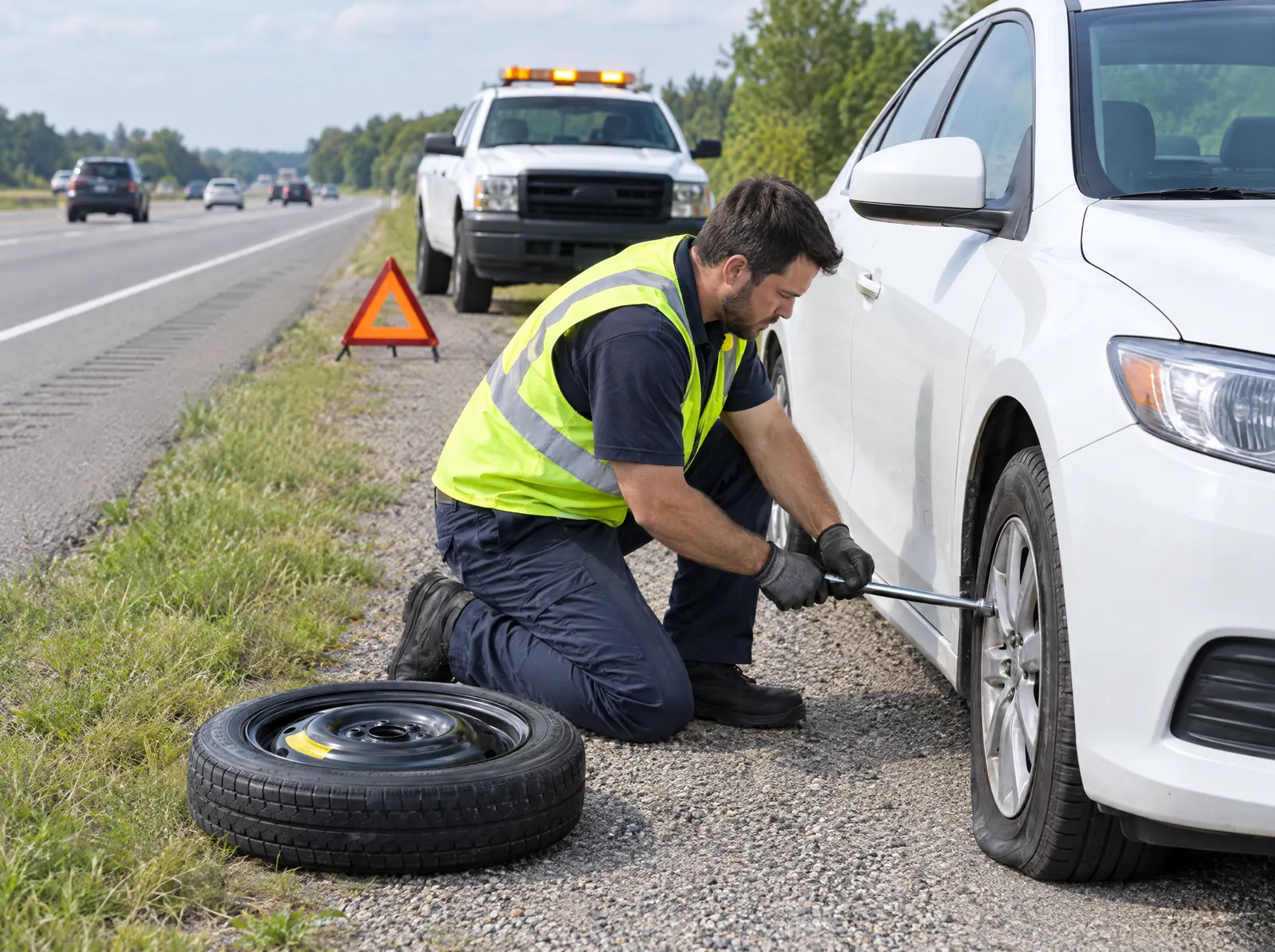
The patrol is built to clear the freeway. It can change a flat, give you a jump, top off a radiator and do small temporary fixes. It can give you one gallon of gas. It has no diesel.
If your car can't be fixed fast, the patrol can pull it to the shoulder or tow it off the freeway to a drop area. That is where its help ends. The state says the patrol can't tow your car to your home or to a repair shop. Once you're off the freeway, you pick your own tow service.
So a dead alternator near the airport may still need a second truck. The patrol gets you out of the lanes. A car tow gets you to your shop in Kalihi, Kaimuki or Kapolei.
One more limit. If you were in a crash, the patrol may not tow your car unless the Honolulu Police Department tells it to.
What should you do the moment your car dies on the H-1?
The state's advice is short: get to the right side of the road, turn on your flashers and call. Here is how that plays out on a busy freeway.
- Signal and drift right while the car still rolls. Don't brake hard in a live lane.
- Stop as far right as you can, past the white line if there's room.
- Flashers on. Seat belt stays on.
- If you're stuck in a travel lane, or anyone is hurt, call 911 first.
- Note your direction and the last exit or overpass you passed.
- Stay in the car unless it is smoking or you smell fuel. Then get out on the side away from traffic and move well back from the road.
Hawaii's move-over law, HRS 291C-27, says drivers must slow down for a tow truck with its lights flashing. They must move a lane over when it's safe. That protects the truck. It doesn't protect you standing next to your bumper.
Why is a rush hour breakdown on the H-1 harder?
On weekday mornings, some H-1 shoulders stop being shoulders. The state opens them as extra travel lanes. On those stretches, the strip you'd pull onto has cars in it.
| Stretch of H-1 | Shoulder used as a lane |
|---|---|
| Eastbound, Kualakai Parkway on-ramp to the Kunia/Waipahu/Ewa exit (Exit 5) | Weekdays, 5 a.m. to 9 a.m. |
| Eastbound, Waiawa Interchange to Halawa Interchange | Weekdays, 5 a.m. to 9 a.m. |
| Westbound, Halawa Interchange to Waimalu Interchange | Weekdays, 3 p.m. to 7 p.m. |
Then there's the Zip lane. It runs eastbound on weekday mornings, 5:30 a.m. to 9 a.m., from Managers Drive to the Keehi Interchange. It's only for cars with 2 or more people. A movable barrier walls it off, so a stall there has no side to escape to. Call 911.
Is the H-1 shoulder closed in town right now?
HDOT's lane closure list for late September 2026 showed two 24/7 right shoulder closures in town for the H-1 Freeway Widening. One is eastbound, from the Ola Lane overpass to Richard Lane. The other is westbound, near the Likelike Highway on-ramp and the Gulick Avenue overpass. The state says these schedules can change without notice. Check its Oahu lane closures page or GoAkamai before a long drive.
If the shoulder you need is closed, keep rolling to the next exit if you safely can. A side street is a far better place to wait than a coned-off lane.
What makes a breakdown on the Pali Highway different?
The Pali Highway is Route 61. It climbs out of Nuuanu, goes through the Pali Tunnels and drops toward Castle Junction, Kailua and Kaneohe. There is no free state patrol here. If you stall, HDOT's advice is to call 911.
The road has a hard history. Landslides closed it after Feb. 18, 2019. The state put up a catchment fence and a rock shed over the Honolulu-bound lanes, just before the second tunnel. Treat the tunnels and the stretch between them as no place to stop on purpose.
- Losing power on the climb: coast to the first wide spot or turnout you see. Don't try to reverse.
- Flat tire near the tunnels: don't change it in a narrow spot. Roll slowly with flashers on to a wider place, if the car can still move.
- Stopped in a lane: stay buckled, flashers on, call 911. Then call for help with the car.
- Telling your driver where you are: say Kailua-bound or Honolulu-bound. Name the last cross street or say which tunnel you passed.
Once police or the road crew say it's clear, a flat tire change or a jump start can often happen right where you've moved to. If your keys end up locked inside while you sort it out, a car lockout service handles that too.
Can you stop the breakdown before it happens?
Not always. But the state's own patrol keeps a short list of the problems it sees most. Fill up when you hit a quarter tank. Check your coolant. Keep the tires at the right pressure, and look at your tread.
Coolant matters on the Pali. A long climb on a warm day is when a low radiator shows up. Watch your temperature needle on the way up. If it climbs, pull off where you can and let the engine cool before it gets worse.
Who helps when the patrol can't?
Nights. Weekends. The Pali. The H-3. A tow all the way to your shop. Those are the times you need your own help.
Sentinel Towing is a towing and roadside network, not a tow company. A vetted local partner tow company on Oahu does the job. We text you a locked price before anyone drives out. Then we check on you by text until help arrives. That is our Stay-With-You Promise. You get your driver's name and photo, and you can track your truck on a map while you wait. Tows stay on Oahu. For more on the island, see towing in Honolulu.
Stuck right now? Call 1-888-TOW-1213, or request help online.
H-1 and Pali Highway Roadside Questions
Is the Freeway Service Patrol really free in Honolulu?
Yes. The state runs it at no cost to you. Call (808) 841-4357 on weekdays from 5 a.m. to 7 p.m. It covers most of the H-1, the H-201 and a short part of the H-2.
Who do I call if I break down on the Pali Highway?
The free patrol does not cover the Pali. HDOT says to call 911 if you're outside its area or it's after hours. Once you're safe from traffic, you can call your own roadside help.
Will the patrol tow my car to my mechanic?
No. It can move your car to the shoulder or a drop area off the freeway. It can't take it home or to a shop. You need a separate tow for that.
What if I stall in the H-1 Zip lane?
Stay buckled with your flashers on and call 911. The barrier leaves nowhere to pull over. Let police manage the traffic before anyone works on your car.
Rules change, so check the official source before you rely on it. Sources: HDOT FSP service area, HDOT FSP questions, HDOT FSP services, HDOT FSP towing, HDOT special use lanes, HDOT Oahu lane closures, HDOT Pali Highway update, HRS 291C-27, GoAkamai.