Costs
What a Tow Costs Near the Grapevine Outside Bakersfield
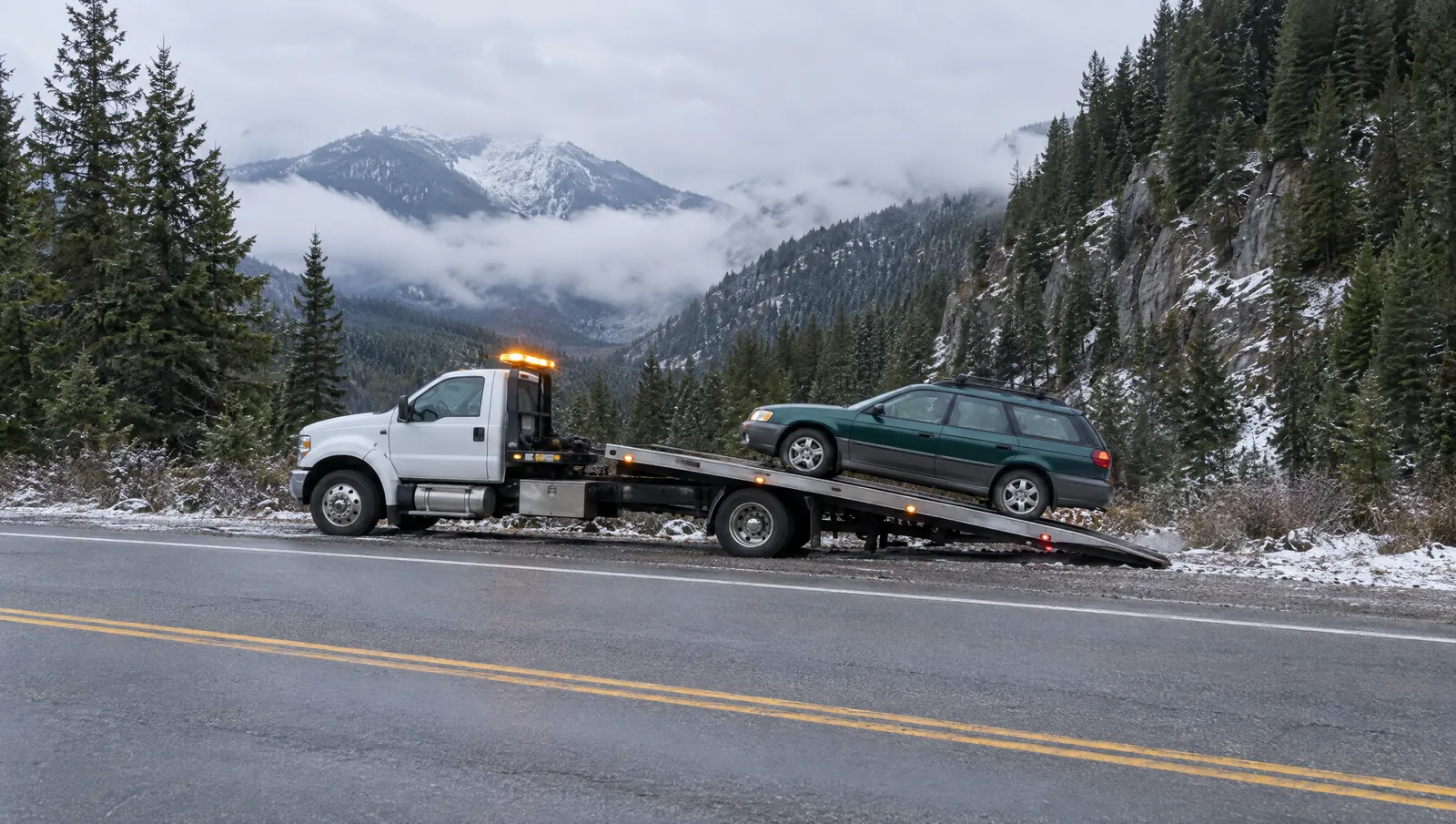
A tow from the Grapevine costs more than a tow inside Bakersfield, mostly because of distance. The truck drives out to I-5 south of town, then hauls your car back. Where you stopped on the 6% grade, which way you were headed and the weather on the pass also change the job. You get your price by text before anyone is sent, and that price is the most you pay.
Why is a Grapevine tow priced differently than a city tow?
Inside Bakersfield, a stall on SR 99 or Rosedale Highway is close to plenty of shops. The Grapevine is a different trip. I-5 skips the city several miles to the west. Then it runs south past the SR 99 split near Wheeler Ridge and starts to climb.
So a tow from the grade has two long legs. Your driver goes out to you, and then hauls you to a shop. California law treats both legs as part of the bill. Under Vehicle Code 22513, the written estimate you get before hookup has to list mileage "from dispatch to return." On the Grapevine, that line is most of the story.
Here's what moves the number on this stretch:
- How far up the grade you are. A car near Grapevine Road at the bottom is a shorter trip than one near Lebec or the summit.
- Where your car is going. A Bakersfield shop, a shop to the south or your home address each make a different haul.
- Where the car sits. A wide shoulder is a simple load. A car down a dirt slope may need a winch-out first.
- What went wrong. Some Grapevine problems don't need a tow at all.
- The weather. Snow on the pass can stop the job until the road opens.
How steep is the Grapevine, and why does that matter?
Caltrans says the Grapevine is a 6% grade for 5 miles. The CHP office in Lebec describes it as running from Fort Tejon Road down to Grapevine Road, with heavy truck traffic. There's a 35 mph speed zone for trucks headed north, down the hill. There are also two runaway truck escape ramps, one on each side.
A long, steady climb is where tired cars give out. A weak cooling system runs hot. An old transmission slips. A tire with a slow leak goes flat at the worst spot. Coming down, brakes can fade if you ride them.
The grade also changes how your driver loads your car. A car stopped on a slope with trucks rolling past is harder to hook up than one on flat ground in town. That's part of why your partner tow company asks exactly where you are before your price is set.
Never stop in an escape ramp
Those deep gravel ramps are for big rigs with failed brakes. If your car quits, use the right shoulder. Don't coast into a ramp unless your own brakes are gone. A car stuck in deep gravel can turn a simple tow into a recovery job.
Does it matter if I was heading north or south?
Yes, more than most people think. Think about where you want the car to end up.
- Heading south, toward Los Angeles. If you live down south, the closest shop toward home may beat a haul back to Bakersfield. Ask for both options.
- Heading north, home to Bakersfield. A tow down the hill and into town gets you to your own mechanic. It's a long haul, but you won't need a second tow later.
- Just passing through. If you're bound for Fresno or the Bay Area, think about which town you'd rather wait in while the car gets fixed.
Tell the dispatcher your direction and the side of the freeway you're on. On a divided road, the truck may need to go past you and turn around to reach your side. Naming your side helps your partner plan the route before the price is set.
Can a lighter job replace the tow?
Often, yes. Matching the job to the problem is the best way to keep the price down on a long stretch like this.
| What happened on the grade | Ask about this first |
|---|---|
| You ran low on gas waiting in slow traffic near the summit | Fuel delivery, enough to reach a station |
| Car won't start after you shut it off at a turnout | A jump start |
| Flat tire on the shoulder, and your spare is good | A spare put on, then you drive on |
| Slid off into soft dirt but nothing is broken | A winch-out back onto the pavement |
| Engine overheated, smells hot or won't move | A car tow. Don't keep climbing. |
Caltrans tells winter drivers to keep the gas tank full, because a storm can force you to turn back or sit in a long delay. On the Grapevine, that advice saves you a call.
If your car runs hot on the climb
Watch your temperature gauge on the way up. If it climbs toward red, pull fully onto the right shoulder. Turn the engine off. Don't open the radiator cap while it's hot. A car that cooled down may run again, but steam or a sweet smell means it needs a shop, not more hill.
What happens to the job when snow closes the pass?
This is the Grapevine's biggest wildcard. Caltrans says full closures of I-5 for snow and ice happen an average of 3 to 5 times between October and April. Most last 4 to 6 hours. Some last longer than 24 hours.
The summit at Tejon Pass sits at 4,144 feet. Caltrans and the CHP start a plan called Operation Snowflake when heavy snow is forecast to drop to 4,500 feet or lower. It moves in phases:
- Phase 1. Snow is falling but may not stick. Traffic still moves on its own.
- Phase 2. Snow is sticking. The CHP paces or escorts groups of cars over the pass.
- Phase 3A. I-5 is closed. SR 58 and SR 166 are open as detours.
- Phase 3B. I-5 and SR 58 are closed. SR 166 is still open.
- Phase 3C. SR 166 closes too. The detour is SR 46 and SR 41 to US 101.
- Phase 3D. US 101 closes as well. There's no way around.
Southbound, the closure starts at Grapevine Road in Kern County. If you're stuck behind it, a tow truck can't drive past the closure to reach you. Caltrans says drivers can now turn back during a closure instead of waiting in place. The CHP and Caltrans don't forecast a reopening time.
So the job waits until the road opens. Conditions can also change the work itself. Snow on the shoulder or a car that slid can mean more work than you first described. If that happens, you get a new price by text first, and you decide.
No chains on the Grapevine
Caltrans doesn't run chain controls here like it does on some passes. Snow is often limited to the summit, and there's no room for drivers to pull off and take chains off. That means plenty of drivers reach snow with no chains and no snow driving experience. Caltrans also notes the road surface can be 4 to 10 degrees colder than the air. A road can freeze on a day that doesn't feel cold.
What are your rights when the tow truck shows up?
If you're at your car and you called the tow yourself, California's Vehicle Code 22513 gives you real protection. Your driver hands you a written, itemized estimate before your car is hooked up. You sign it and keep a copy. After that, no charge can go past the estimate unless you agree first.
There's one twist on a busy grade. If police or a public agency asks, a car in a dangerous spot can be moved to the nearest safe shoulder first. The paperwork happens there. Tows ordered by the CHP under its own contract follow other rules. Sentinel doesn't do police-ordered tows or impounds.
How does Sentinel price a Grapevine job?
Sentinel Towing is a towing and roadside network, not a tow company. A vetted local partner tow company does the work. You tell us where you are on I-5, which way you were going and where the car should end up. If a partner can reach you that far south, we text you the price before dispatch. That price is the most you pay for the job. Then we check on you by text until the truck arrives, as part of our Stay-With-You Promise. You can also track your truck on a map.
For the rest of the area, from Oildale to the SR 58 grade, see our Bakersfield towing page.
What should I do while I wait on the grade?
- Get fully onto the right shoulder, as far from traffic as you can.
- Turn your hazard lights on. Under Vehicle Code 21809, passing drivers must move over a lane when they safely can, or slow down.
- Stay buckled in your car if you can't get well away from the lanes. Trucks pass close on this road.
- Note the last sign you passed, like Fort Tejon Road, Lebec Road or Grapevine Road.
- Check closures on Caltrans QuickMap or call 1-800-427-7623.
If anyone is hurt, or your car is stuck in a live lane, call 911 first.
Stuck right now? Call 1-888-TOW-1213, or request help online.
Grapevine Tow Cost Questions
Why does a tow from the Grapevine cost more than one in Bakersfield?
Mostly miles. The truck travels out to I-5 south of town and then hauls your car back. California estimates must count mileage from dispatch to return. The grade and the weather can add work too.
Can a tow truck reach me during a Grapevine snow closure?
Not past the closure. No one drives in until the CHP opens the road. Caltrans says drivers can now turn back instead of waiting in place. Call once the road is open or you're clear of it.
Should I tow my car back to Bakersfield or to a shop down south?
It depends on where you live and where you were headed. A shorter haul usually costs less. Your own mechanic may still be worth the trip if you'd need a second tow later.
Do I need chains to drive the Grapevine?
Caltrans doesn't set chain controls on the Grapevine. When snow sticks, the CHP escorts traffic or closes the road. Check QuickMap before you leave Bakersfield in winter.
Rules change, so check the official source before you rely on it. Sources: Caltrans Operation Snowflake brochure, Caltrans News Flash #218, Caltrans winter driving tips, CHP Fort Tejon Area, California Vehicle Code 22513, California Vehicle Code 21809, Caltrans QuickMap.